

Sarmayegozarebartar
SGBTC Score
Every scoring input for this plan is verified.
Overview
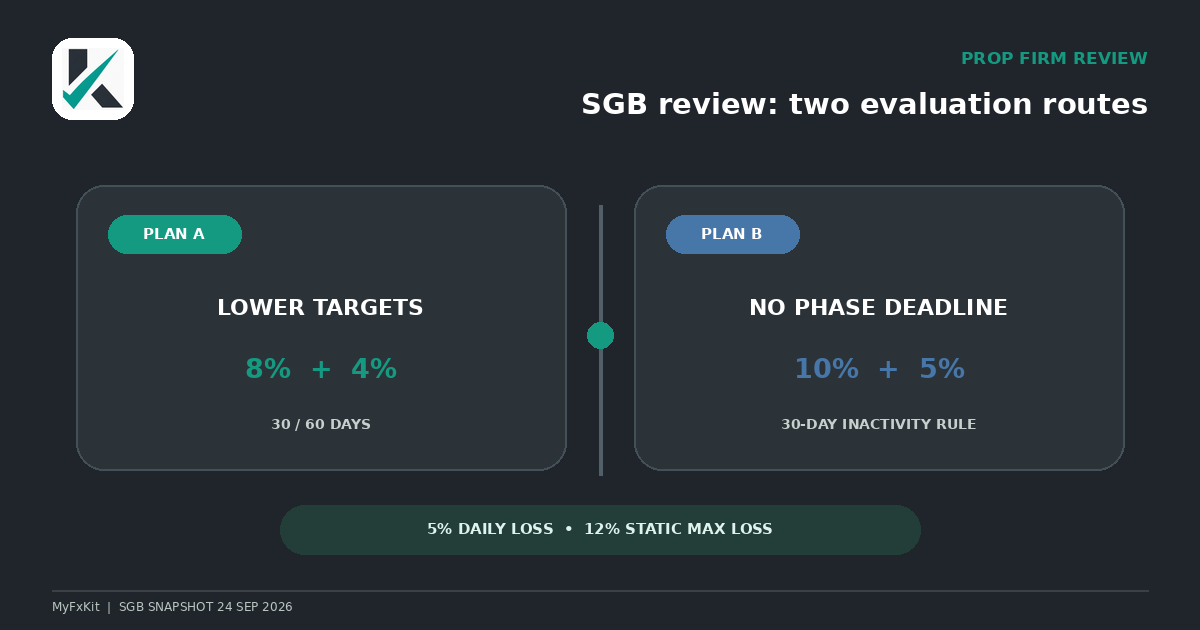
Sarmaye Gozare Bartar, commonly referred to as SGB, offers two main evaluation routes: Plan A combines lower profit targets with phase deadlines, while Plan B removes the completion deadline but raises the targets. That headline difference is only the beginning. Traders also need to account for SGB's simultaneous-risk cap, sub-30-second trade rule, restrictions on automated trading and VPS use, and tiered payout structure.
Author: MyFxKit Content Team
Technical review: MyFxKit Technical Team
Official sources checked: September 24, 2026
Snapshot ID: MFK-FIRM-SGB-2026-09-24-01
This review is not financial advice and does not guarantee that a trader will pass an evaluation or receive a reward. Prices, product availability and rules can change. The agreement, checkout page and account-specific rules in force on the purchase date remain the final reference.
SGB review: the quick verdict
- Plan A uses 8% and 4% targets, requires at least five trading days per phase, and applies 30-day and 60-day calendar deadlines. The stated trader share starts at 80% and can rise to 85% from the third month.
- Plan B uses 10% and 5% targets, requires at least three trading days per phase, and has no stated deadline for completing the targets. A 30-day inactivity rule still applies.
- Both plans state a 5% daily drawdown based on the start-of-day balance and a fixed 12% maximum drawdown based on the initial balance.
- The stated risk cap for a single position or all simultaneously open positions is 3% on account sizes from $1K to $50K and 2% on $100K and $200K accounts.
- Automated trading robots and VPS use are prohibited. Trade-management tools and some copying arrangements are allowed only under specified conditions.
- Profits from winning trades held for less than 30 seconds can trigger an account reset when they exceed 20% of the phase target or withdrawable reward.
- SGB explicitly describes its accounts as simulated. Payments to successful traders are performance rewards rather than profits generated in a live brokerage account.
What is SGB?
Sarmaye Gozare Bartar describes itself as an Iranian trader-evaluation platform operating since 2021. Its About page states that challenge and funded-stage accounts operate in a simulated environment and that the company is not a broker, bank, investment fund or asset manager.
The website identifies Sarmaye Gozare Bartar Ltd. with registration number 2025-00343 in Saint Lucia and lists an operating address in Dubai. Company registration is not the same as financial regulation. A registration number may identify a commercial entity, but it does not by itself establish a brokerage licence, asset-management authorisation or regulatory protection for payouts. See the MyFxKit guide to prop firm regulation for this distinction.
SGB says it publishes payout reports with transaction hashes on Telegram and that approved payments are often processed in less than 24 hours. That processing claim should be separated from the eligibility period before a request, the compliance review and the final transfer. They are three different stages.
SGB Plan A vs Plan B
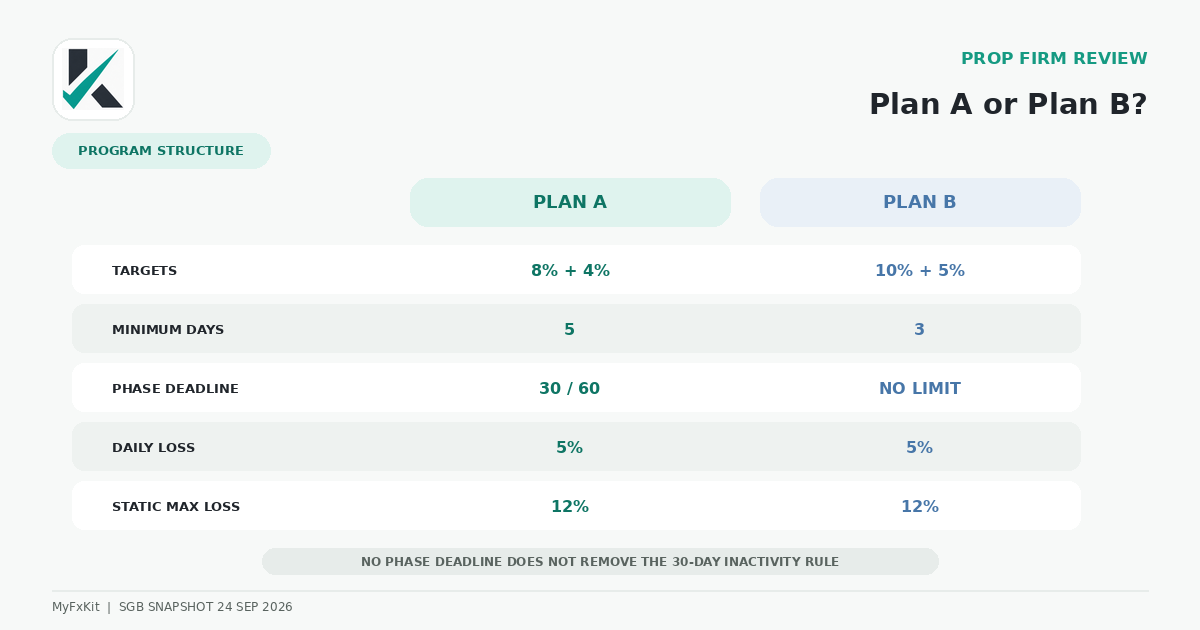
| Feature | Plan A | Plan B |
|---|---|---|
| Evaluation phases | 2 | 2 |
| Phase-one target | 8% | 10% |
| Phase-two target | 4% | 5% |
| Daily drawdown | 5% | 5% |
| Maximum drawdown | 12% fixed | 12% fixed |
| Minimum trading days per phase | 5 | 3 |
| Completion deadline | 30 days for phase one; 60 days for phase two | None stated |
| Inactivity rule | 30 days | 30 days |
| Stated scaling ceiling | $1 million | $2 million |
| Trader reward share | 80%, then up to 85% | 75% to 90% on a tiered schedule |
| News trading | Allowed | Allowed |
| Overnight and weekend holding | Allowed | Allowed |
| Automated trading robot | Prohibited | Prohibited |
| VPS | Prohibited | Prohibited |
Plan A offers the shorter numerical path: its two stated targets add up to 12%, compared with 15% for Plan B. Plan B removes the phase-completion deadline and reduces the minimum trading-day requirement from five days to three.
The phrase “no time limit” must not be interpreted as permanent account availability. Under the general rules, the first trade must be placed within 30 calendar days of the order, and the gap between subsequent trades must not exceed 30 days. A trader can therefore progress more slowly in Plan B, but cannot leave the account inactive indefinitely.
SGB account prices
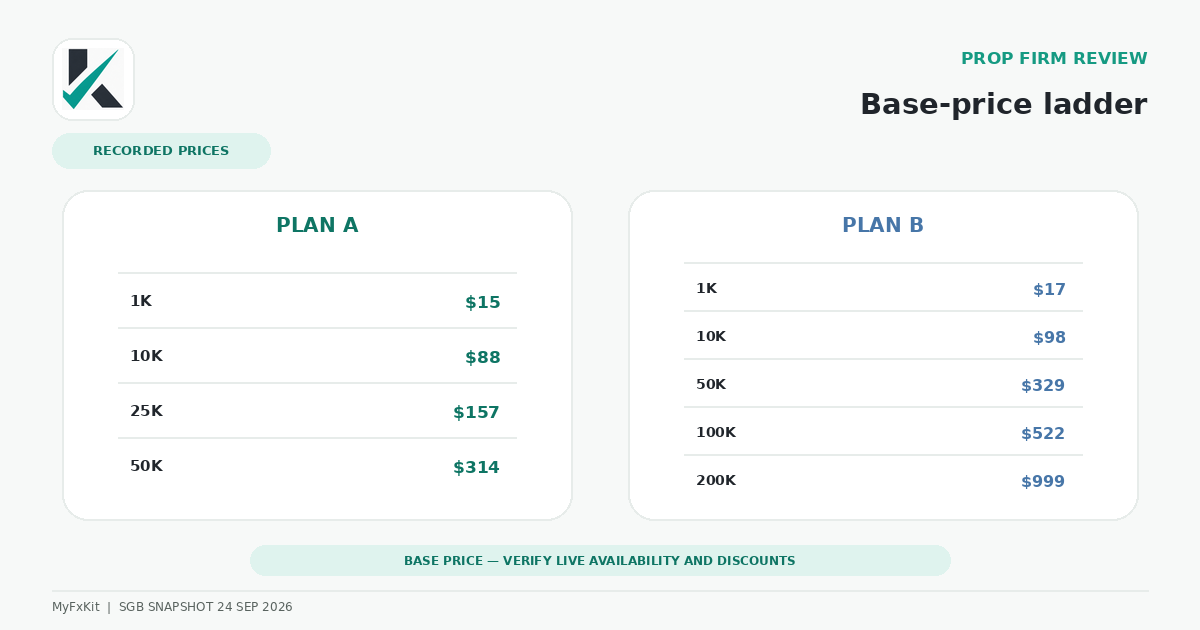
| Account size | Plan A | Plan B |
|---|---|---|
| $1,000 | $15 | $17 |
| $2,500 | $30 | $35 |
| $5,000 | $55 | $60 |
| $10,000 | $88 | $98 |
| $25,000 | $157 | $174 |
| $50,000 | $314 | $329 |
| $100,000 | Not displayed for Plan A | $522 |
| $200,000 | Not displayed for Plan A | $999 |
These were the base prices recorded on the review date and exclude temporary discounts. At that time, the official page also stated that Plan B purchases were available from $1K to $200K, while Plan A purchases were active from $1K to $10K. A price shown in an older table does not guarantee that the same account size can be purchased today.
Do not evaluate value by looking only at the $15 difference between the two $50K products. The probability of missing Plan A's deadline, Plan B's higher targets, the reward-share schedule and compatibility with your own trading history can all change the effective cost.
How does the 5% daily drawdown work?
According to the official Plan A rules and Plan B rules, daily drawdown is calculated from the account balance at midnight server time. Neither balance nor equity may touch or cross the daily floor.
For a $50,000 account with a $50,000 start-of-day balance:
Daily floor = $50,000 − 5% = $47,500
If a trade remains open at the start of the new day, the difference between balance and equity does not replace the stated reference. The rules say the calculation still begins with the start-of-day balance. At the time of review, SGB stated that its server time differed from Tehran time by three hours and 30 minutes. Server settings can change, so verify the actual reset inside the platform.
Treat an exact touch of $47,500 as a breach. The rules describe touching either the daily or maximum drawdown as a violation. Commission, swap, spread and slippage should therefore be included in a safety buffer rather than added after the risk calculation.
Fixed 12% maximum drawdown
Maximum drawdown is fixed against the initial balance. On a $50K account:
Maximum-drawdown floor = $50,000 − 12% = $44,000
Making a profit does not raise this floor. If the account grows from $50,000 to $55,000, the maximum-loss floor remains $44,000, increasing the nominal distance from the new peak. If SGB formally scales the account, the floor is recalculated from the new account size.
This formula is simpler than a trailing drawdown, but the daily limit and separate risk-management rule may become restrictive first. The prop firm drawdown guide explains the difference between fixed and moving loss floors.
The 3% and 2% risk-management rule
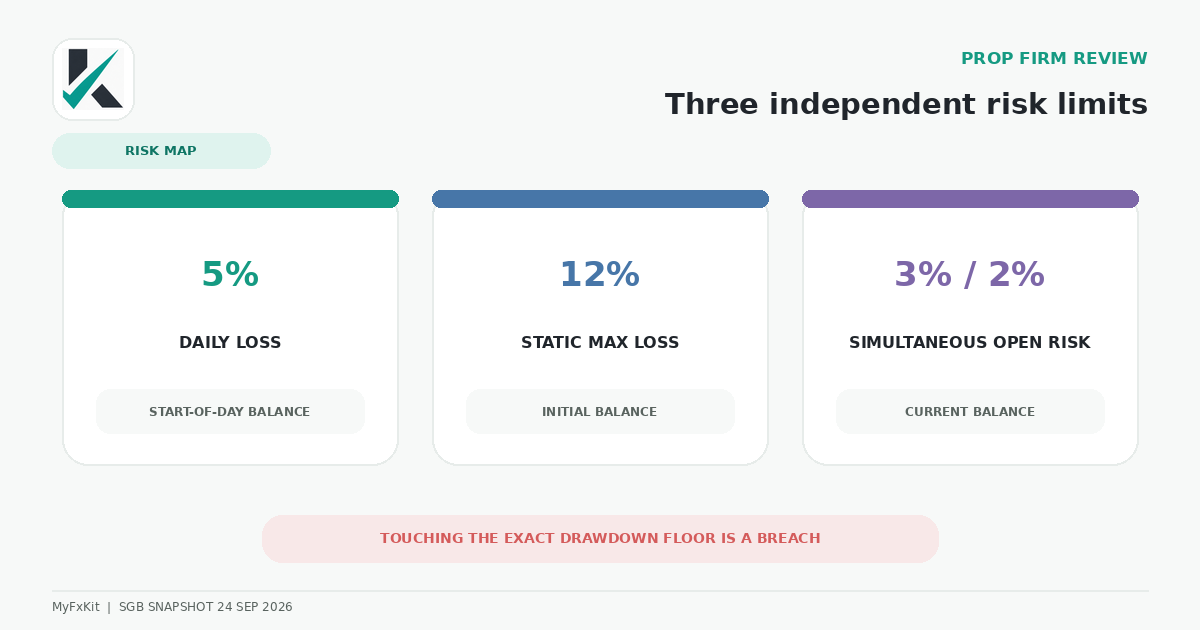
In addition to daily and maximum drawdown, SGB states a separate cap for one position or the combined loss on simultaneously open positions:
- $1K, $2.5K, $5K, $10K, $25K and $50K accounts: maximum 3%.
- $100K and $200K accounts: maximum 2%.
The rules identify current balance as the reference and state that the equity decline relative to current balance must not exceed the applicable percentage. On a $10K account, for example, a fall in equity from $10,000 to below $9,700 would cross the 3% limit.
This is not the same as daily drawdown. After closing one losing position, a trader may continue trading while respecting each new risk window and the remaining daily allowance. What the trader cannot do is allow the combined floating loss on open positions to cross the simultaneous-risk threshold.
The official wording distinguishes some slippage-related cases from deliberate excess risk. However, the 5% daily drawdown and 12% maximum drawdown remain breaches even when slippage is involved. The safer operating assumption is not to rely on an exception and to keep planned risk below 3% or 2%. The floating-loss rule guide can help model overlapping positions.
The sub-30-second trade rule
SGB does not state that every trade shorter than 30 seconds is automatically prohibited. The rule focuses on profits from winning trades closed in less than 30 seconds. If their combined profit exceeds 20% of the phase target or final withdrawable reward, the account can be reset.
Example for a $10K Plan B phase-one account:
Phase-one target = $1,000
Sub-30-second profit allowance = 20% × $1,000 = $200
The official example treats an amount below $200 as acceptable and an amount above it as grounds for a reset. Because the public wording does not resolve every exact-boundary scenario, treat exactly $200 as unavailable rather than planning to trade on the edge.
At the funded stage, the denominator is the withdrawable reward. The percentage can therefore change as the final profit changes. Review the relevant trades before requesting a payout, not after submitting the request.
Expert advisers, copying and VPS use
Automated trading robots are prohibited on both plans. SGB describes risk-management utilities, such as manual order-management panels, as permissible. Copy trading is allowed only under stated conditions. If trades are copied between an external account and SGB, the rules say the source account must be held within SGB.
Copying between accounts belonging to the same verified identity is described as permissible. Copying across different identities, coordinated group trading, shared IP addresses, shared devices and shared login information are prohibited. Having another person manage the account is also treated as a violation.
VPS use is expressly prohibited. This is a material restriction for anyone who depends on a fixed IP, reduced connectivity risk or remote execution of trade-management software. Before purchasing, send support the exact name of your tool and your proposed connection setup, then retain the written answer.
News trading and weekend holding
News trading is allowed. SGB nevertheless warns about wider spreads and slippage and reserves the right to act against exploitation of bugs or abnormal conditions. Permission to trade news does not permit latency arbitrage or taking advantage of an erroneous price feed.
Overnight and weekend holding are allowed. However, the activation of an order on Saturday or Sunday while global markets are closed is stated to be prohibited, including for crypto. “Weekend holding” therefore does not mean unrestricted cryptocurrency execution throughout the weekend.
The MyFxKit guides to news trading in prop firms and weekend holding cover stop-loss, take-profit and reopening-gap scenarios.
Plan A payouts
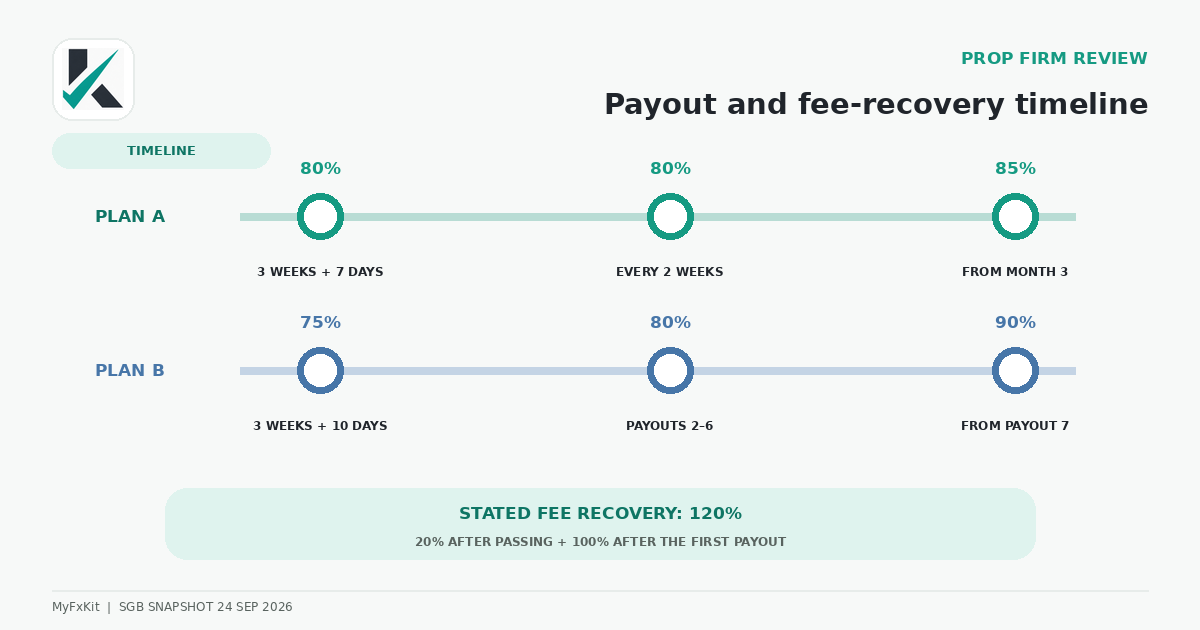
For the first Plan A payout, at least three weeks must have passed since the first trade on the funded-stage account, and at least seven trading days must be completed. The stated trader share is 80% during the first two months and can rise to 85% from the third month. After the first payout, requests are available every two weeks.
There must be no open trade from the moment the request is submitted until the payment is completed. The rules also state that every request withdraws the entire eligible account profit; the trader cannot leave part of that profit behind.
Plan B payouts
Plan B uses a tiered schedule:
| Payout stage | Trader share | Stated interval |
|---|---|---|
| First payout | 75% | After three weeks and at least 10 trading days |
| Second through sixth payouts | 80% | Every two weeks |
| Seventh payout onward | 90% | Weekly |
The advertised “up to 90%” depends on reaching the later tier. The first Plan B payout does not use a 90% trader share, and this distinction should be included in any value comparison.
SGB states that rewards are transferred in USDT. Confirm the network, transfer fee, minimum amount and time from approval to transfer before purchasing. For operational wallet risks, see the prop firm payout guide for Iranian traders.
How does the stated 120% fee refund work?
The rules for both plans state the following structure:
- 20% of the evaluation fee after successfully completing both phases.
- 100% of the evaluation fee after the first payout.
- Total stated recovery: 120%.
SGB states that the request for the 20% portion must be made no later than 45 days after receiving the funded-stage account. Missing this window can forfeit that portion. A refund should not be treated as guaranteed income: passing, maintaining compliance, requesting within the deadline and completing a successful payout are practical prerequisites.
Account scaling
SGB states that accounts may be scaled by 40% in three-month intervals. The principal conditions include completing three months on the funded-stage account, achieving at least 8% cumulative positive performance across those three months and requesting scaling after a reward payment.
The stated scaling ceilings are $1 million for Plan A and $2 million for Plan B. These figures are long-term programme ceilings, not balances assigned immediately after purchase.
Platform and trading conditions
Accounts are offered on MetaTrader 5 through an SGB-branded server. The published leverage schedule was 1:100 for currency pairs and metals, 1:20 for oil and Brent, 1:50 for the Dow Jones, 1:100 for other indices and 1:10 for crypto.
MT5 availability does not prove execution quality. Before purchasing, verify spread, commission, swap, slippage, contract size and server hours for the instruments you actually trade. The term ECN also does not by itself establish the real execution path or counterparty model, particularly when the company itself describes the accounts as simulated.
Identity verification and Iranian access
The rules state a minimum age of 18 and identify passports, Iranian national identity cards and birth certificates as accepted identity documents. The payer's details must match the person registered on the website. Follow this requirement from the start because a purchase made by another person may create problems during identity verification or payout review.
The website lists regional restrictions involving the United States, North Korea, Russia, Myanmar and other prohibited jurisdictions. Because restricted-country lists can change, an Iranian-facing service or acceptance of Iranian identity documents should not be treated as permanent approval for every country of residence. Confirm your nationality, residence, IP location, address document and payment method in writing.
SGB strengths
- Two clearly differentiated routes that trade a lower target against removal of the phase deadline.
- A fixed 12% maximum drawdown with a relatively clear description of the calculation base.
- Plan B account sizes ranging from $1K to $200K at the time of review.
- News trading plus overnight and weekend holding are allowed.
- Publicly stated payout, refund and scaling structures.
- Conditional copying between accounts belonging to the same verified identity.
- Acceptance of common Iranian identity documents.
Important weaknesses and restrictions
- A separate 3% or 2% cap on risk across simultaneously open trades.
- Automated trading robots and VPS use are prohibited.
- The 20% sub-30-second-profit rule is tested against the phase target or withdrawable reward.
- Plan B starts with a 75% share, and the 90% tier is not reached until the seventh payout.
- Plan A has phase deadlines, and purchasable sizes were limited when checked.
- The 30-day inactivity rule remains in force even on the no-time-limit plan.
- A funded-stage breach can make the remaining profit ineligible for withdrawal.
Which SGB plan fits which trader?
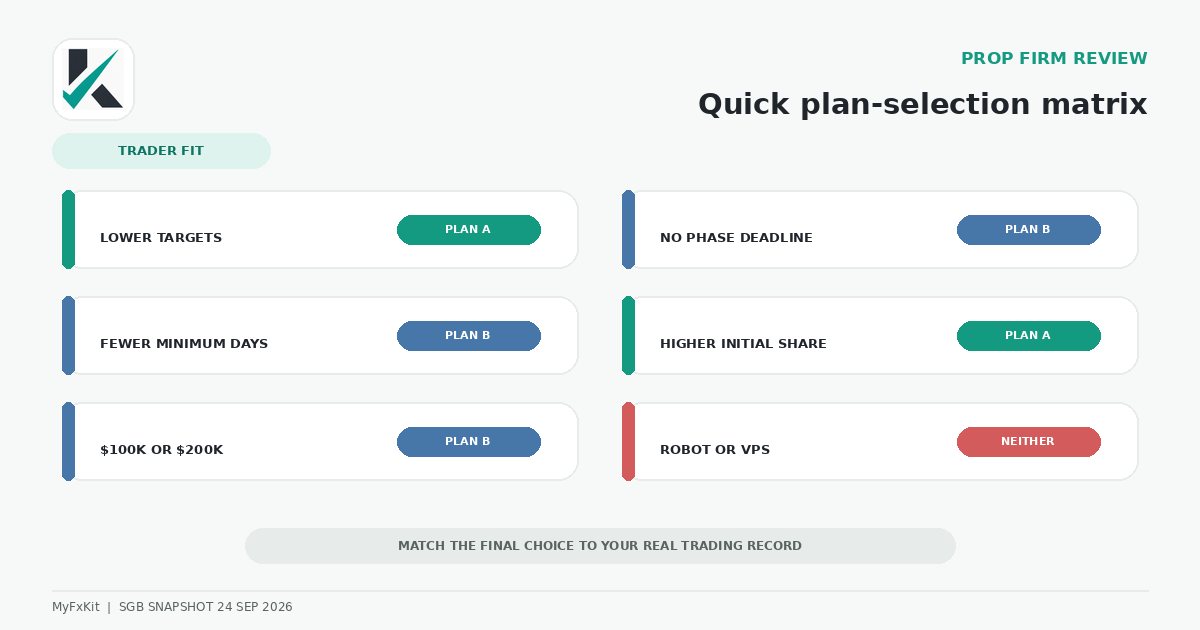
| Priority | First option to examine | Reason | Main obstacle |
|---|---|---|---|
| Lower targets | Plan A | 8% and 4% targets | Phase deadlines |
| More completion time | Plan B | No stated phase deadline | 30-day inactivity rule |
| Fewer minimum days | Plan B | Three days per phase | Higher targets |
| Higher initial share | Plan A | Starts at 80% | Stated ceiling of 85% |
| Higher eventual share | Plan B | Can reach 90% | Requires the seventh payout |
| $100K or $200K account | Plan B | Larger available sizes | 2% simultaneous-risk cap |
| Automated robot or VPS | Neither | Both are prohibited | Another listed firm is required |
| Very fast scalping | Use caution | Some sub-30-second profit may be tolerated | 20% profit threshold |
If an automated trading robot or VPS is essential to your method, a low SGB entry price does not make the product compatible. Start with the MyFxKit collection of EA-friendly prop firms and verify the current directory before choosing an alternative.
SGB pre-purchase checklist
- Confirm the account sizes actually available for Plan A or Plan B on the purchase date.
- Save the rules and account terms as a PDF or screenshot.
- Verify the daily reset time inside MT5.
- Keep risk per position and combined open risk below the 3% or 2% threshold.
- Calculate the share of target or withdrawable profit created by sub-30-second trades.
- Obtain a written answer about your trade-management tool, copier, IP and device setup.
- Record the first-payout requirements, trading-day count and tiered reward share.
- Add the 45-day deadline for requesting the 20% refund portion to your calendar.
- Keep the payer, account holder and reward recipient names aligned.
- Do not trade exactly on a legal threshold; leave room for slippage and trading costs.
Final verdict
SGB is worth examining for traders who want an Iranian-facing service, MetaTrader 5, weekend holding, news trading and a fixed 12% maximum drawdown. Plan A offers the shorter target path and higher initial share; Plan B provides more time, larger account sizes and a route to a 90% share.
Drawdown alone should not decide the purchase. The simultaneous-risk cap, sub-30-second rule, EA and VPS restrictions, and payout conditions may matter more than the difference in price. A suitable choice requires matching these rules against an actual trading record rather than an intended strategy.
For comparison with another firm currently included in the MyFxKit directory, read the Propia review. Compare the specific programmes and settings rather than relying on brand names alone.
Frequently asked questions
What is the main difference between SGB Plan A and Plan B?
Plan A has 8% and 4% targets and phase deadlines. Plan B has 10% and 5% targets, no stated phase-completion deadline and fewer minimum trading days.
Is SGB Plan B genuinely unlimited in time?
No final deadline is stated for reaching the target, but a 30-day inactivity rule remains. The first trade and subsequent activity must stay within the applicable inactivity window.
Are expert advisers allowed at SGB?
Automated trading robots are prohibited. Risk-management tools and some copying arrangements are conditionally allowed. VPS use is also prohibited.
Is touching the drawdown limit a breach?
Yes. The official rules describe touching the 5% daily drawdown or 12% maximum drawdown as a violation. Traders should maintain a safety margin.
When is the first SGB payout available?
Both plans require at least three weeks from the first funded-stage trade. Plan A also requires at least seven trading days, while Plan B requires at least 10 trading days.
How is the stated 120% fee refund paid?
SGB states that 20% is available after completing both evaluation phases and 100% after the first payout. The 20% portion must be requested within the stated 45-day window after receiving the funded-stage account.
Are news trading and weekend holding allowed?
Both are described as allowed. Activating orders while global markets are closed on Saturday and Sunday is prohibited, including for crypto, and gap and slippage risk remains with the trader.
When was this SGB review researched?
The official sources were checked on September 24, 2026. The snapshot identifier is MFK-FIRM-SGB-2026-09-24-01.
Official sources reviewed
Update history: First edition published from the September 24, 2026 source snapshot, covering prices, product availability, targets, drawdown, simultaneous risk, fast-trade limits, payouts, fee refunds, scaling and platform restrictions.
Rules & policies
Challenges & pricing
| Plan | Type | Account | Price | Split | Daily DD | Total DD | Model | Payout | TC |
|---|---|---|---|---|---|---|---|---|---|
| Plan A | 2-step | $10,000 | $88 | 80% | 5% | 12% | Static | Bi-weekly | 78.69 |
| Plan A | 2-step | $2,500 | $30 | 80% | 5% | 12% | Static | Bi-weekly | 78.69 |
| Plan A | 2-step | $5,000 | $55 | 80% | 5% | 12% | Static | Bi-weekly | 78.69 |
| Plan A | 2-step | $1,000 | $15 | 80% | 5% | 12% | Static | Bi-weekly | 78.69 |
| Plan B | 2-step | $2,500 | $35 | 75% | 5% | 12% | Static | Bi-weekly | 75.87 |
| Plan B | 2-step | $5,000 | $60 | 75% | 5% | 12% | Static | Bi-weekly | 75.87 |
| Plan B | 2-step | $50,000 | $329 | 75% | 5% | 12% | Static | Bi-weekly | 75.87 |
| Plan B | 2-step | $200,000 | $999 | 75% | 5% | 12% | Static | Bi-weekly | 75.87 |
| Plan B | 2-step | $10,000 | $98 | 75% | 5% | 12% | Static | Bi-weekly | 75.87 |
| Plan B | 2-step | $25,000 | $174 | 75% | 5% | 12% | Static | Bi-weekly | 75.87 |
| Plan B | 2-step | $1,000 | $17 | 75% | 5% | 12% | Static | Bi-weekly | 75.87 |
| Plan B | 2-step | $100,000 | $522 | 75% | 5% | 12% | Static | Bi-weekly | 75.87 |
The highest-scoring plans on this page are shaded. The exact score is in the last column. Scroll the table sideways to see every column.
How this score was calculated
The TC Score is not an opinion — it is arithmetic over published rules. Every input below is measured against the same scale for all firms on the board, so a component score of 70 means “better than most of the firms we list”, not “good in the abstract”. Here is the full working for this firm’s best plan.
Every scoring input is verified for this plan.
The three blocks
What a round turn actually costs you.
How much room the firm gives you to trade your way.
The constraints you have to trade inside.
What lifts this score
- Gold leverage— 1:100+4.5 pts vs an average firm · controls 9% of the score
- Consistency rule— No rule+3.5 pts vs an average firm · controls 7% of the score
- Daily drawdown— 5.0%+2.4 pts vs an average firm · controls 9% of the score
What holds this score back
- Per-trade risk cap— 3%−2.6 pts vs an average firm · controls 11% of the score
- Gold spread— 3.20−1.8 pts vs an average firm · controls 21% of the score
- Expert advisors (EAs)— Not allowed−1.2 pts vs an average firm · controls 3% of the score
Every component
| Component | This firm | Across all firms | Score | Share |
|---|---|---|---|---|
| Gold spread Cost of trading | 3.20 | 1.00 best → 4.80 worst | 41.2 | 21.0% |
| Commission per lot Cost of trading | $4.50 | $0.00 best → $7.00 worst | 46.0 | 14.0% |
| Gold leverage Freedom to trade | 1:100 9.62 gold lots | 1:100 best → 1:8 worst | 100.0 | 9.0% |
| Profit split Freedom to trade | 80% | 90% best → 50% worst | 46.5 | 7.5% |
| Total drawdown Freedom to trade | 12.0% | 12% best → 3% worst | 89.8 | 4.5% |
| News trading Freedom to trade | Allowed | — | 100.0 | 3.0% |
| Expert advisors (EAs) Freedom to trade | Not allowed | — | 10.0 | 3.0% |
| Weekend holding Freedom to trade | Allowed | — | 100.0 | 3.0% |
| Profit target Rules & restrictions | 8.0% | 0% best → 10% worst | 50.3 | 8.8% |
| Daily drawdown Rules & restrictions | 5.0% | 5% best → 2% worst | 77.2 | 8.8% |
| Per-trade risk cap Rules & restrictions | 3% | — | 25.0 | 10.5% |
| Consistency rule Rules & restrictions | No rule | 100% best → 15% worst | 100.0 | 7.0% |
The range column shows the real best and worst values among the firms we list. Scoring uses a statistical scale (the board average plus or minus two standard deviations), which is why a component can score above 0 or below 100 without matching either extreme exactly.
The three blocks combine to a raw 58.69, which is then mapped onto the published 50–90 display range, giving 78.69.
Using this firm from Iran
Separate from the TC Score on purpose. That score rates the trading rules; this one answers whether you can buy and get paid at all. A firm can be excellent at one and useless at the other.
Accepts rial directly, so there is no USDT on-ramp to arrange first.
- Accepts Iranian traders
- Accepts rial payment
- Accepts USDT / crypto
- Publishes its rules in Persian
Based on the firm’s published terms and payment methods. Verify directly before paying — terms change, and enforcement varies.
Payment methods
Get told when SGB changes its rules
Prices, drawdown, payout terms — when this firm changes something we track, our Telegram bot messages the people following it. Free, opt-in, one tap to leave.
Follow on TelegramCheck this firm’s rules
Further reading
Common questions
How much does a Sarmayegozarebartar challenge cost?
Sarmayegozarebartar currently sells 12 plans, from $15 to $999. The cheapest is $15, which buys a $1,000 account. That is a one-off entry fee — once you are funded, the profit split and the risk rules move far more money over a year than the fee does.
What profit split does Sarmayegozarebartar pay?
It depends on the plan: Sarmayegozarebartar's split ranges from 75% to 80%. On every $1,000 withdrawn that spread is $50, and unlike the entry fee it repeats on every payout.
How soon can you withdraw from Sarmayegozarebartar?
The first withdrawal from Sarmayegozarebartar is available after 21 days. After that, payouts run bi-weekly. That is the wait for the FIRST payout only and says nothing about later ones.
What are Sarmayegozarebartar's drawdown rules?
Sarmayegozarebartar caps daily loss at 5% and total loss at 12%. Total drawdown is static, measured from your starting balance, so profit you make does not drag the limit up behind you.
Does Sarmayegozarebartar have a consistency rule?
No — on the data we have verified, Sarmayegozarebartar imposes no single-day profit cap. One outsized day cannot fail the account on its own, which is not true of every firm.
Does Sarmayegozarebartar accept Iranian traders?
Yes. Sarmayegozarebartar accepts Iranian traders and it accepts rial payment, which is the easiest case because it removes the whole USDT on-ramp.
Data is gathered from public sources and the firm’s own materials, may be out of date, and is provided “as is” with no guarantee. Nothing here is financial advice — always verify directly with the firm before buying a challenge.
Back to the leaderboard