
Are Prop Firms Regulated? How to Verify Licences and Trust
Learn when prop firms may need financial authorisation, how company registration differs from regulation, and how to verify licence claims.
The short answer to “are prop firms regulated?” is that prop firms do not all share one business model or regulatory status. Many retail challenge providers offer simulated accounts and state that they are not brokers, asset managers or investment-service providers. Other businesses may execute real trades, copy trading activity, provide brokerage services or perform another function that can require financial authorisation depending on the jurisdiction and the exact service.
The most important distinction is that company registration is not financial regulation. A company number, registered address and director record may prove that a legal entity exists. Only the relevant regulator's public record can show whether that same entity is authorised to perform a particular financial activity.
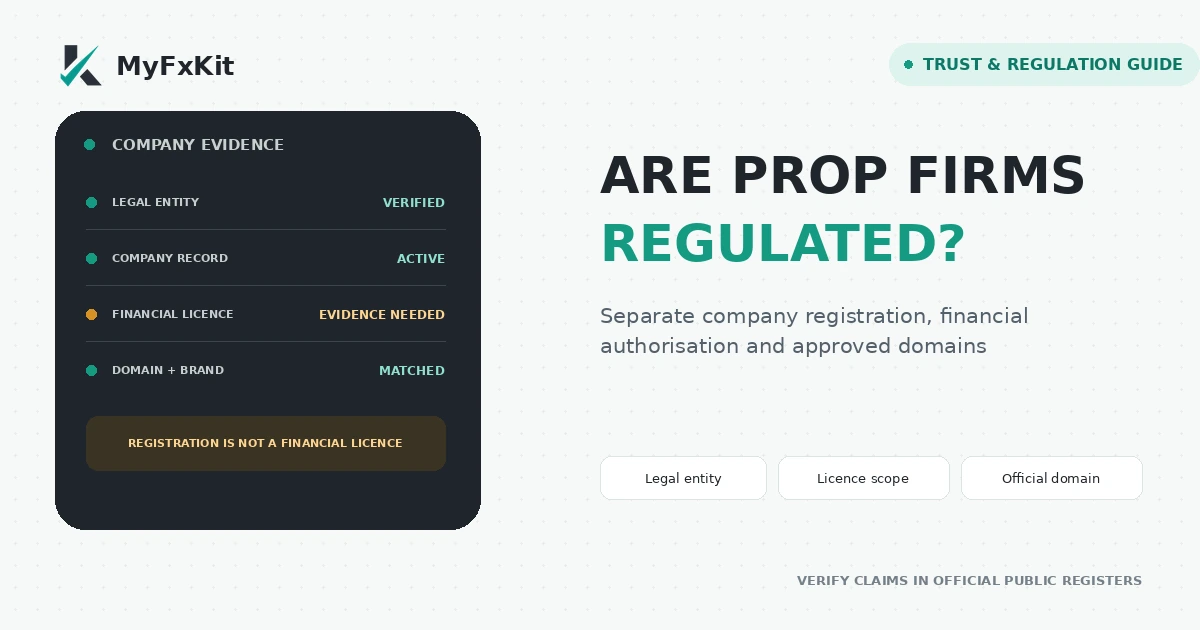
A proper prop firm check separates the legal entity, account model, financial authorisation, approved domain and customer contract.
Written by: MyFxKit Content Team · Technical review: MyFxKit Technical Team
Official sources last checked: August 31, 2026. Licence status, approved domains, directors and regulatory warnings can change. This guide is a research framework, not legal advice.
Are prop firms required to be regulated?
The word “prop” is not enough to determine whether a licence is legally required. The answer normally depends on the firm's real activities, its jurisdiction, the customer's location, the financial instrument involved, who holds money and the contractual relationship between the parties.
One company may sell an evaluation, record all trades in a simulated environment and pay a contractual performance reward. Another may accept trading funds, execute customer orders, manage an account or provide personal investment advice. Those two businesses do not necessarily sit inside the same legal category.
Two broad statements should therefore be avoided:
- “Every prop firm without a brokerage licence is operating illegally.”
- “A company trading its own money can never require financial authorisation.”
A defensible conclusion must refer to the same legal entity, service, jurisdiction and point in time.
What does regulated mean?
A regulated or authorised firm has received permission from the competent authority to perform specified activities and must meet the obligations attached to that permission.
A complete regulatory claim should identify:
- The full legal-entity name;
- The regulator;
- The licence or regulatory registration number;
- The current status;
- The authorised services and financial instruments;
- The trading name and approved website domain;
- Any geographic or customer-category restrictions;
- The date the information was checked.
Phrases such as Registered, Licensed Company or Internationally Regulated are not sufficient evidence when these details are missing.
Three businesses that may all be called prop firms
| Model | Typical activity | Main regulatory question |
|---|---|---|
| Traditional proprietary trading firm | Trades the firm's capital through employees or contracted traders | Does its trading, market membership or corporate structure require a specific permission? |
| Retail evaluation provider | Sells challenges and records trading on simulated accounts | Is the service outside financial-services licensing, or does part of the activity enter the regulated perimeter? |
| Brokerage or hybrid model | Executes orders, accepts trading funds, manages accounts or routes trades to a market | Which permissions cover execution, derivatives, advice, management or custody? |
This table is a research classification, not a legal determination. A single brand may use one entity to sell challenges, another to operate the platform and another to pay rewards.
Company registration versus financial regulation
Company registration generally shows that a legal person has been incorporated and that basic corporate information appears in a public company register. Financial authorisation shows that a regulator has permitted that same legal person to perform specified activities.
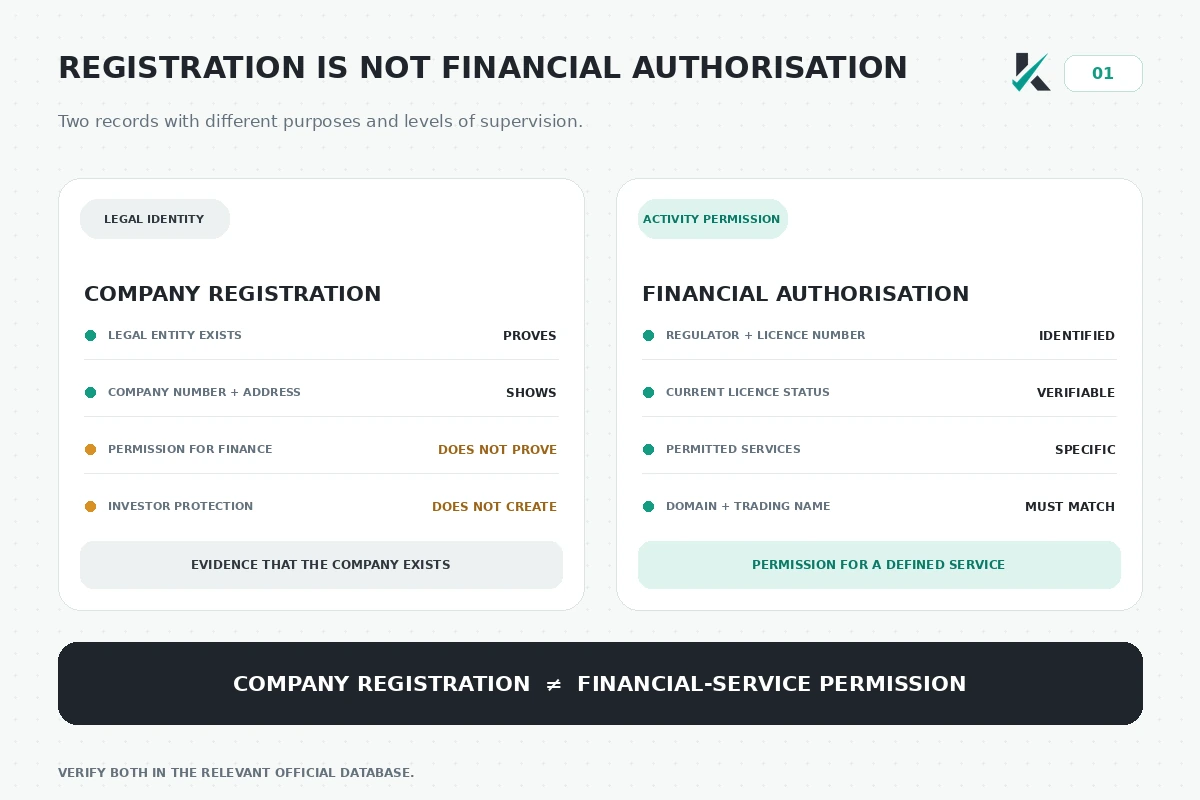
| Question | Company registration | Financial authorisation |
|---|---|---|
| Does it prove the legal entity exists? | Yes, subject to the status of the record | Usually, together with the regulatory identity |
| Does it show a company number and address? | Usually | It may repeat those details |
| Does it permit investment services? | No | Only the services listed in the permission |
| Does it create financial supervision? | No | To the extent required by the licence |
| Does it establish capital and conduct requirements? | Not as a financial authorisation | It may, depending on the permission |
| Does it create complaint or compensation protection? | Not by itself | Only when the service and customer qualify |
The FCA's official guidance distinguishes authorisation from other forms of registration: an authorised firm must meet standards and has permission to provide particular products and services. FCA guidance for international applicants also treats Companies House incorporation as a separate step that comes before seeking FCA authorisation.
Simple rule: a company number evidences the company's existence; a regulator's licence number evidences permission for a defined activity.
When can a prop firm's activity enter the regulatory perimeter?
The boundary differs by country, but the following questions are useful for an initial assessment:
- Does the firm hold customer money for trading or investment?
- Does it execute or transmit a customer's order?
- Is real trading performed in an account legally owned by the customer?
- Does the firm provide personal recommendations to buy or sell financial instruments?
- Does it have discretion to manage an account?
- Is the customer's profit or loss directly tied to capital they supplied?
- Does it offer forex, CFDs or another derivative contract to a retail customer?
- Are simulated trades copied into live markets, and how is that relationship documented?
In the European Union, ESMA's investor guidance says firms may provide investment services only when authorised by an EU regulator and that authorised firms must appear in a public register. In the United States, CFTC guidance advises users to verify the registration and disciplinary history of people or firms involved with forex and derivatives.
These principles do not mean that every seller of a simulated evaluation is automatically an investment firm. The real service and the applicable law must be assessed.
What have regulators said about retail prop firms?
In March 2024, Belgium's Financial Services and Markets Authority warned consumers about a model it described as a shadow investment game. The regulator explained that users paid for challenges, traded in a demo environment and might have selected simulated trades copied by the firm. It also stated that the prop trading companies discussed did not hold authorisation to provide investment services.
In July 2024, the Italian market regulator Consob published a communication about the growth of models described as funded trading, financed trading accounts and shadow investment games.
These regulatory notices matter, but they must be interpreted carefully:
- A regulator's warning about a particular model or market is not a worldwide legal ruling.
- A company not appearing on a warning list has not thereby been approved.
- Absence of a licence proves a regulatory violation only when the company performs an activity for which that authorisation is required.
- A firm's statement that it does not require a licence should be tested against its actual business model and the relevant jurisdiction, not accepted as marketing fact.
What does not prove that a prop firm is regulated?
The following items may provide useful operational information, but none replaces a live regulator record:
- A certificate of incorporation;
- A tax number;
- A registered office or coworking address;
- KYC or identity verification;
- Use of MetaTrader, cTrader or another recognised platform;
- A commercial payment processor;
- A business bank account;
- An ISO certificate or membership in a private association;
- A statement that funds are segregated without a defined scope and evidence;
- A relationship with a regulated broker;
- A regulator logo in the website footer;
- A link to a licence held by another group entity.
Some of these factors can support an operational trust assessment. They are not the same as financial authorisation.
How to verify a prop firm licence step by step
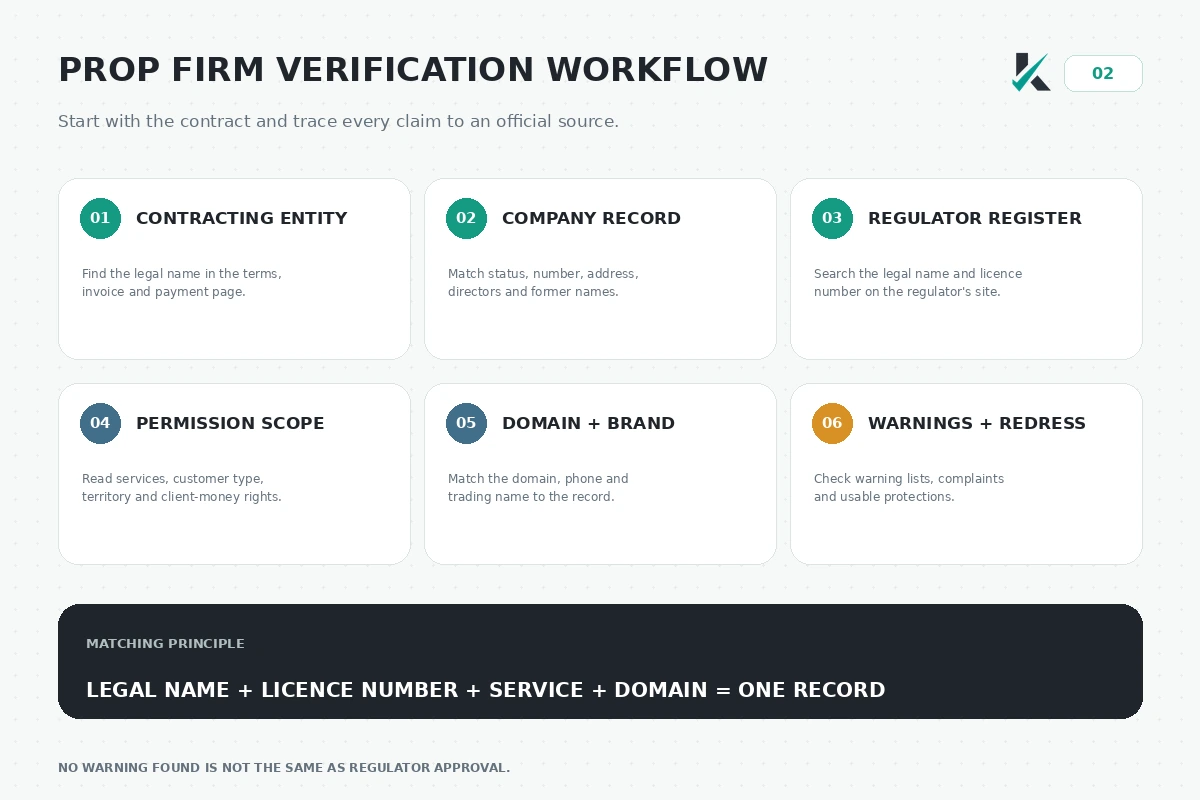
1. Identify the contracting legal entity
Do not stop at the website footer. Check the terms of use, user agreement, refund policy, invoice and payment merchant name. The entity with which the customer contracts should be clear.
When several companies are named, separate their roles:
- Challenge seller;
- Brand owner;
- Platform operator;
- Account issuer;
- Reward payer;
- Broker or execution provider.
2. Check the company register
Match the legal name, company number, active or dissolved status, incorporation date, address, directors and former names. Company existence is the first checkpoint, not the final trust verdict.
3. Search the regulator's own register
Search with the legal name and the claimed licence number. A brand name may not return a result because regulatory registers usually identify the legal entity.
4. Read the status and scope of permission
Finding the entity is not enough. Verify:
Active,Authorisedor equivalent status;- Start date and any end date;
- Permitted services and financial instruments;
- Retail or professional customer restrictions;
- Permission to hold client money;
- Countries in which the service may be provided;
- Disciplinary action, restrictions or licence cancellation.
5. Match the domain and contact details
Clone firms may copy a genuine company's name and licence number. The website, email address, telephone number and office details should match the regulator's record or its approved-domain list.
6. Search official warning lists
Search the legal name, brand, domain and directors in the relevant warning list and the IOSCO International Securities and Commodities Alerts Network. No warning is not an endorsement, but an official warning is a serious risk signal.
7. Determine which protections apply to you
Even when a company is authorised, establish whether the same service, domain and customers in your country fall within the permission. Compensation or ombudsman protection may not cover an unregulated product, an affiliate or a customer outside the relevant jurisdiction.
8. Save dated evidence
Keep copies of the terms, regulator result, licence page, invoice and support answers. Entities, domains and contractual rules can change later.
Official registers for licence checks
| Jurisdiction | Official source | What to verify |
|---|---|---|
| United Kingdom | FCA Firm Checker and FCA Warning List | Authorisation, permitted services, status, trading names and unauthorised-firm warnings |
| European Union | ESMA authorised-firm guidance and register plus the national regulator | Legal entity, active status and permitted investment services |
| United States | CFTC Check and NFA BASIC | Registration category, disciplinary history and available financial information |
| Australia | ASIC Professional Registers | AFS licence number and status, services, representatives and conditions |
| Cyprus | CySEC Investment Firms Register | Licence number, company status, trading names and approved domains |
| Multiple jurisdictions | IOSCO I-SCAN | Alerts supplied by IOSCO members about unauthorised entities and domains |
Enter registers from the regulator's official domain. A third-party database, support screenshot or certificate hosted on the firm's website is not a substitute for a direct search.
Why exact permissions matter
Financial licences are not universal passes. An authorised company can be permitted for one activity but not another, or may serve professional clients but not retail customers.
For example, a record may distinguish among:
- Executing orders;
- Receiving and transmitting orders;
- Dealing on own account;
- Portfolio management;
- Investment advice;
- Holding client money;
- Offering specified financial instruments;
- Serving customers in particular countries.
The company name appearing in a regulator database proves only what the record actually says. Read the permissions, restrictions, status and associated domain rather than converting the result into a generic “regulated” badge.
What if the prop firm works with a regulated broker?
A relationship with a licensed broker may matter for infrastructure, possible execution or identity checks. The broker's licence does not automatically transfer to the prop company.
Answer these questions separately:
- Which company contracts with the customer for the challenge?
- Which legal entity receives the payment?
- Which company owes the performance reward?
- Is the account simulated or live?
- If live, who legally owns the account?
- What service does the broker provide to the prop firm?
- Does the permission or agency record identify the prop brand, domain and relevant service?
- Is a complaint about execution handled differently from a reward dispute?
An execution complaint might fall inside the broker's complaint process while a challenge-fee or reward dispute remains a contractual matter with the prop firm. Do not assume that both receive the same regulatory protection.
What can regulation provide?
Depending on the permission, jurisdiction and service, regulation can create requirements concerning capital, reporting, internal controls, customer treatment, risk disclosures, client-money handling or complaint procedures.
The FCA says using an authorised firm with the correct permissions can reduce the risk of harm. It also explains that its checker cannot guarantee that compensation-scheme or ombudsman protection applies to every case. ESMA similarly warns that dealing with an unauthorised investment firm can remove access to important regulatory protections.
The CFTC registration guide notes that registration can involve background checks, financial requirements, verified business information, examinations, supervision and conduct standards. The same guide also states that registration and a clean record cannot eliminate fraud risk.
What regulation does not guarantee
Authorisation alone does not guarantee:
- That a trader will be profitable;
- That an evaluation will be passed;
- That every reward request will be approved without a rule review;
- That product prices and rules will never change;
- That the company will receive no customer complaints;
- That every affiliate is covered;
- That every country and customer qualifies for protection;
- That a simulated account is protected as an investment service.
Trust should combine regulatory evidence with legal transparency, operational history, fair terms, support quality and payment evidence.
Red flags in a regulation claim
The following issues require further investigation or stopping the purchase:
- A regulator is named but no licence number is provided;
- The licence number belongs to a different company;
- Legal names differ across the website, contract and payment page;
- The website domain is absent from the regulator's approved details;
- The permission is expired, cancelled or restricted;
- The authorised services do not cover the claimed activity;
- Incorporation is marketed as a forex or investment licence;
- Compensation protection is claimed without eligibility details;
- A certificate image is supplied without a verifiable regulator link;
- Support gives an unclear answer about the contracting entity;
- The contracting entity changes repeatedly without clear notice;
- The name or domain appears in an official warning;
- Payment through an irreversible method is demanded without a clear invoice and contract.
One warning sign does not always prove fraud. A false licence claim or use of another firm's regulatory identity should be treated as a severe issue.
Does a clean warning-list search prove safety?
No. Warning lists are not complete approvals databases. A regulator may not yet know about a company, may lack jurisdiction, or may not consider the service regulated under its rules.
Record the result as “no warning found on the checked date,” not “approved by the regulator.” Positive verification requires separate evidence such as corporate identity, a matching licence where claimed, clear contracts and an understandable account model.
Account model and payout contract still matter
A regulation review should record whether the account is simulated, live or hybrid. It should also identify which entity decides eligibility for rewards and where disputes are governed.
Important contract fields include:
- The legal entity selling the evaluation;
- The legal nature of the challenge fee;
- The stated status of simulated funds;
- The calculation and approval process for rewards;
- The firm's power to change rules or terminate accounts;
- The governing law and dispute forum;
- Refund and chargeback provisions;
- Country, identity and payment restrictions.
An incorporated company can still use unclear terms. An authorised company can also offer a product outside the scope of a particular protection. Regulation research and contract review must be performed together.
International and restricted-country checks
A company's licence does not mean it can serve every country. Before purchase, compare nationality, residence, identity-document country, payment method and reward destination with the official terms.
Check:
- Prohibited and restricted-country lists;
- How the contract treats nationality versus residence;
- Whether your identity documents are accepted;
- Permitted reward-payment methods;
- The firm's right to suspend an account under sanctions or payment-provider rules;
- The governing jurisdiction for disputes;
- Whether a complaint can realistically be pursued from your country.
Acceptance of the initial fee does not prove that the customer will remain eligible for identity verification or rewards.
How MyFxKit should display prop firm trust
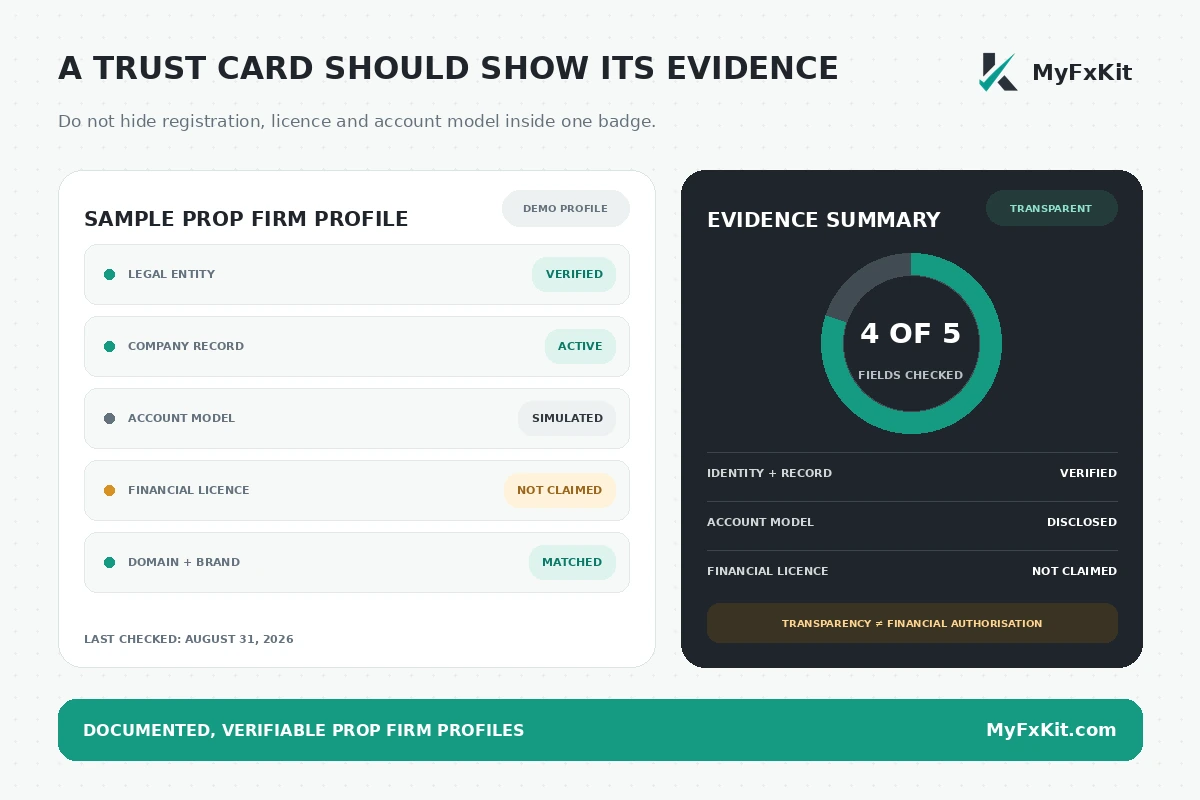
Company registration, financial authorisation and operating history should be separate fields on every profile. A single Verified badge can hide materially different evidence.
Recommended MyFxKit fields:
| Field | Suggested statuses |
|---|---|
| Legal entity | Verified, not found, insufficient information |
| Company registration | Active, inactive, dissolved, under review |
| Account model | Simulated, live, hybrid, unclear |
| Financial authorisation | Verified, not claimed, not found, legal review required |
| Permission scope | Service, customer type and geographic coverage |
| Brand and domain match | Verified, mismatch, unclear |
| Official warning | None found as of date, warning found, not checked |
| Reward-contract entity | Legal name and jurisdiction |
| Last verification | Exact date with the source link |
“No warning found” must always include a date and must not be presented as a safety guarantee. The scoring method should be explained in the MyFxKit methodology.
Prop challenge pre-purchase checklist
Complete these checks before paying:
- Extract the contracting legal entity from the terms.
- Verify its company registration and current status.
- Search every licence claim in the regulator's own database.
- Match the permission, domain, trading name and restrictions.
- Search regulator and IOSCO warning lists.
- Identify whether the account is simulated, live or hybrid.
- Identify the entity responsible for rewards and disputes.
- Read country, KYC and payment restrictions.
- Compare the rules with the drawdown guide, FLR guide and consistency rule guide.
- Save dated copies of evidence and support answers.
Frequently asked questions
Does UK company registration mean a prop firm is FCA-regulated?
No. Companies House incorporation and FCA authorisation are separate. Search the same legal entity in the FCA Firm Checker or Financial Services Register and read its current permissions.
Is every unlicensed prop firm untrustworthy?
No. Lack of a brokerage licence does not by itself prove that every simulated-evaluation business is fraudulent or unlawful. First determine what service the firm actually provides and whether that activity requires authorisation in the relevant jurisdiction. The absence of financial supervision may still reduce the protection available to the customer.
Does a regulated broker make its prop firm partner regulated?
No. A permission belongs to specified legal entities and activities. Review the contract and licence scope to understand the broker's role and which disputes, if any, fall inside its regulated service.
Does a demo account never require regulation?
Simulation is an important factor, but it is not a complete legal conclusion. Marketing, trade copying, reward arrangements, money handling and local law can affect the analysis.
Is finding the company in a regulator database enough?
No. The status must be current, the permission must cover the service and the domain or trading name must match. Clone scams may copy a genuine firm's licence number.
Does no official warning mean the prop firm is safe?
No. Warning lists are incomplete and retrospective. Treat the result as one data point alongside corporate records, contracts, operating history and the account model.
Does regulation guarantee prop firm rewards?
No. Identify which entity owes the reward and whether that obligation falls inside a regulated service. Ombudsman or compensation protection is not identical for every product, affiliate or customer.
Final answer
To determine whether a prop firm is regulated, do not rely on a logo, company number or the firm's own description. Identify the business model and contracting entity, then verify incorporation, financial permission, authorised services, domain, warnings and customer protection through official sources.
Use the MyFxKit prop firm directory, prop firm rules pages, broker profiles and published research methodology together. A firm can be transparently incorporated but not financially authorised, or it can hold a licence that does not cover the product being reviewed.
Before buying a challenge, do not reduce trust to one badge. Verify the legal entity, service, licence, domain and contract separately.