
Prop Firm Drawdown: Daily and Maximum Loss Explained
Learn how prop firm drawdown works with formulas, six examples, balance vs equity, and clear comparisons of static and trailing loss limits.
A visual guide to daily drawdown, maximum drawdown and the distance between an account and its breach level.
Prepared by the MyFxKit Content Team and technically reviewed by the MyFxKit Technical Team. Firm-specific rules last checked on August 30, 2026.
A prop firm account can still show a profit and fail because its equity crossed a loss limit for only a few seconds. The opposite can also happen: no single disastrous trading day, but a series of smaller losses eventually reaches the maximum drawdown floor.
The phrase “5% drawdown” does not tell you enough to calculate the risk. You still need to know:
- Is the 5% limit daily or overall?
- Is it calculated from the initial balance, start-of-day balance or start-of-day equity?
- Do open positions and floating losses count?
- Is the breach floor static, or does it trail account profits?
- When does the trading day reset, and in which time zone?
This guide answers those questions with formulas and worked examples. To calculate the exact dollar levels for your own account, use the MyFxKit prop firm drawdown calculator.
Quick answer: Daily drawdown limits how much an account may lose during one trading day. Maximum drawdown defines the lowest balance or equity allowed during the life of the account. The limits operate independently, so an account can breach one while still having room under the other.
What is drawdown in a prop firm account?
In a prop firm account, drawdown is the permitted distance between a defined reference value and the balance or equity level at which the account breaches its rules.
That is not always the same as drawdown in investment-performance analysis. Performance drawdown usually measures the decline from a peak in capital to a later trough. A prop firm instead defines a contractual breach floor, and that floor may be daily, static or trailing.
Keep these three values separate:
| Value | Practical meaning |
|---|---|
| Initial balance | The account size at the start of the challenge or funded stage |
| Loss allowance | The dollar amount the rules allow the account to lose |
| Breach level | The lowest permitted balance or equity under the applicable rule |
For a $100,000 account with a static 10% maximum drawdown:
Maximum total loss = $100,000 × 10% = $10,000
Maximum-loss floor = $100,000 − $10,000 = $90,000
If the firm monitors equity, even a momentary drop to or through its defined breach level may fail the account. The trade does not need to close first, and a later market recovery may not reverse the violation.
Daily drawdown vs maximum drawdown
Daily drawdown
Daily drawdown, also called the daily loss limit or maximum daily loss, caps the loss allowed during one trading day. The limit is recalculated at a time defined by the firm, usually according to its server or platform clock.
The basic formula is:
Daily loss allowance = Daily reference amount × Daily loss percentageThe important phrase is daily reference amount. Depending on the program, it may be:
- The initial account balance
- The balance recorded at the start of the trading day
- The equity recorded at the start of the trading day
- The higher of start-of-day balance or equity
Closed profit and loss, floating loss, commissions, swaps and other fees may also enter the daily calculation. A percentage shown on a sales page is therefore not enough to understand the rule.
Maximum drawdown
Maximum drawdown, also called maximum loss or overall drawdown, sets the lowest permitted account level across the challenge or funded account.
For a static model, the common formula is:
Maximum loss allowance = Initial balance × Maximum drawdown percentage
Maximum-loss floor = Initial balance − Maximum loss allowance
Unlike a daily limit, this floor does not reset at the beginning of a new day. If a $100,000 account has a static $90,000 floor, gradually moving toward $90,000 is just as serious as reaching it through one large loss.
Balance or equity: which value triggers the breach?
Balance reflects the result of closed trades. Equity adds the live profit or loss of open positions to the balance.
Equity = Balance + Floating profit or lossSuppose the account balance is $101,000 while the open positions show a $6,200 loss:
Equity = $101,000 − $6,200 = $94,800If the daily floor is $95,000 and the firm monitors equity, the account has breached even though the balance still displays $101,000.
This is one of the most common drawdown mistakes: the trader watches closed results while the risk system watches the lowest live equity. In the breach-checker tab of the drawdown calculator, enter the start-of-day balance and current equity to measure the account against both limits.
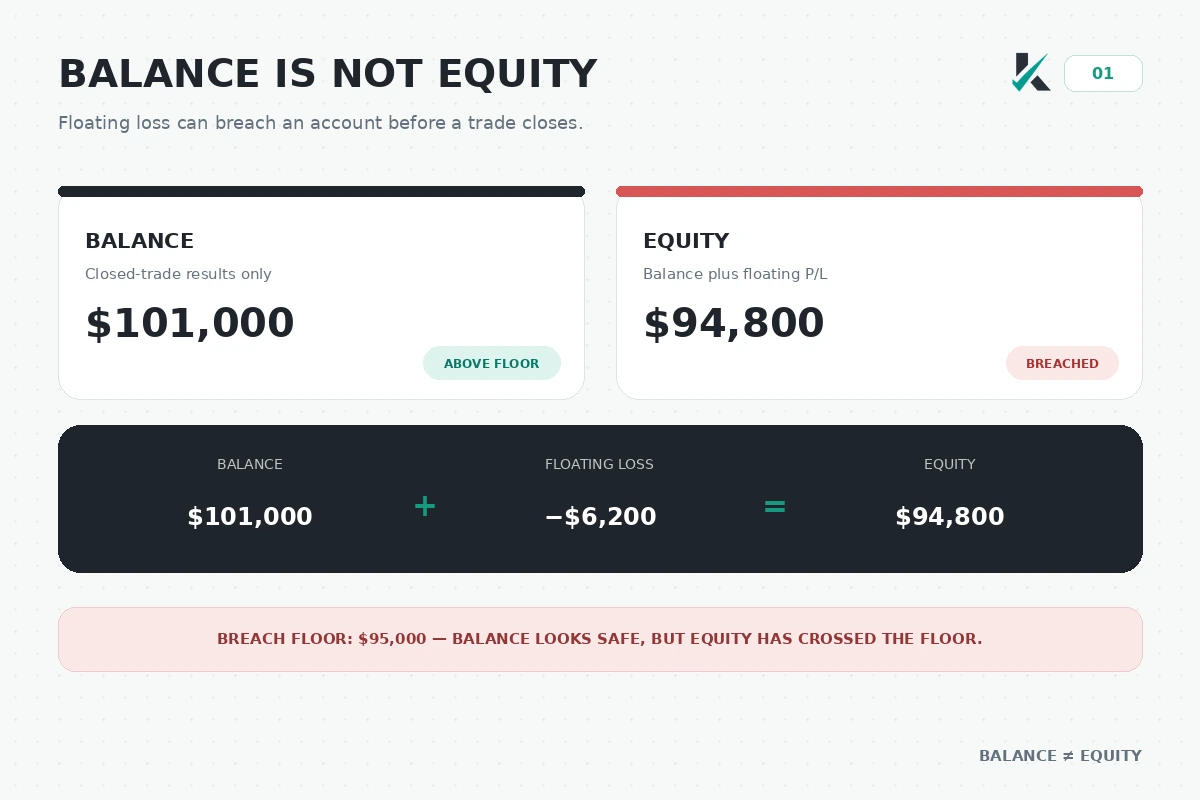
Balance includes closed trades; equity also includes the floating profit and loss of open positions.
Static vs trailing drawdown
Static drawdown
With static drawdown, the maximum-loss floor is calculated from the initial account balance and does not rise when the account makes a profit.
A $100,000 account with a static 10% maximum loss has a $90,000 floor. If the balance grows to $108,000, that floor remains $90,000 unless a stage transition, payout or another program-specific condition changes it.
Trailing drawdown
With trailing drawdown, the breach floor follows a high-water mark based on the highest recorded balance or equity. When the account establishes a new high, the floor moves upward.
Two common calculation methods are:
Fixed-dollar-distance method:
Trailing floor = High-water mark − Original dollar loss allowance

Percentage-of-high-water-mark method:
Trailing floor = High-water mark × (1 − Drawdown percentage)
Some programs trail intraday equity, some use closed balance, and others update only at the end of the trading day. A program may also stop the floor at the initial balance or another lock level. “Trailing drawdown” is not a complete rule until those details are known.
The MyFxKit calculator uses the fixed-dollar-distance method. It first calculates a dollar allowance from the initial balance, then subtracts the same amount from the highest balance entered:
Dollar loss allowance = Initial balance × Maximum drawdown percentage
MyFxKit trailing floor = Highest recorded balance − Dollar loss allowance
That is the calculator’s model, not a universal formula for every prop firm. If a program applies a percentage to its high-water mark, trails equity instead of balance or locks the floor, its own method must be used.
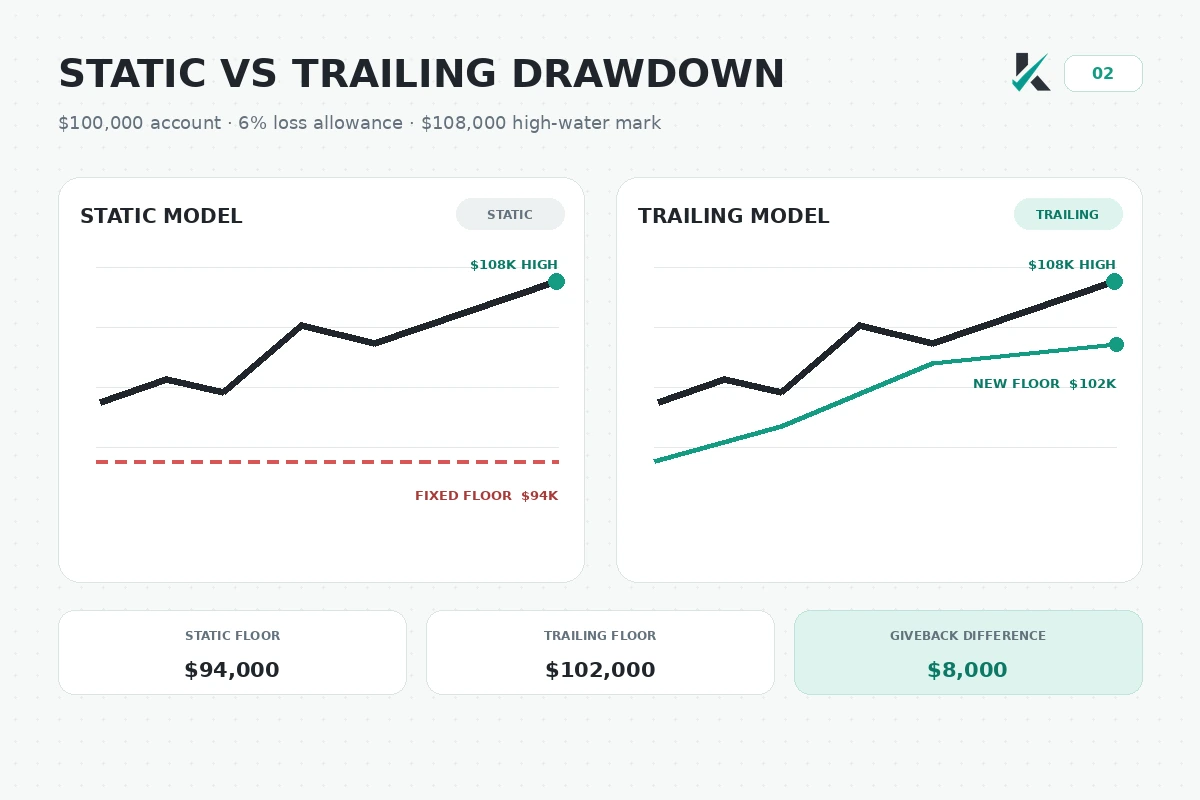
A static floor stays in place. A trailing floor rises as the account records new highs.
Six prop firm drawdown examples
Example 1: A $100,000 account with 5% daily and 10% maximum loss
Assume a 5% daily limit and a static 10% maximum limit:
Daily loss allowance = $100,000 × 5% = $5,000
Maximum loss allowance = $100,000 × 10% = $10,000
Maximum-loss floor = $90,000
If current equity is $96,000, the account has used $4,000 of both dollar allowances:
- Daily limit used: 80%
- Maximum limit used: 40%
The daily limit is the tighter restriction at that moment.
Example 2: Closed profit followed by a larger floating loss
The account starts the day at $100,000. The trader first closes $2,000 in profit, lifting balance to $102,000. Open positions then fall to a $7,100 floating loss:
Current equity = $102,000 − $7,100 = $94,900
Net result for the day = $94,900 − $100,000 = −$5,100
With a $5,000 daily allowance, the daily rule has been breached. The static maximum-loss floor may still be $90,000, but that does not protect the account from a separate daily violation.
Early profit does not make the daily rule irrelevant. Track the net daily result using the firm’s exact formula.
Example 3: Previous profit raises today’s daily floor
The account has grown from $100,000 to $103,000 over earlier days. Suppose the program subtracts a fixed $5,000 daily allowance from the start-of-day balance:
Today’s daily floor = $103,000 − $5,000 = $98,000An equity reading of $97,900 breaches the daily rule, even though a static maximum-loss floor may remain at $90,000.
Example 4: Balance looks positive while equity breaches
Balance is $101,000 and equity is $94,800. If the daily floor is $95,000 and the program monitors equity, the account is in breach. Whether the open position later closes does not change the fact that live equity crossed the permitted level.
Example 5: Profit does not move a static maximum-loss floor
A $100,000 account with a static $90,000 floor grows to $108,000, then falls to $90,500 in equity.
The decline from the account high is $17,500, but equity is still $500 above the contractual static floor. This shows why prop firm drawdown is not automatically the same as percentage decline from the latest equity peak.
Example 6: One percentage, two trailing results
The initial balance is $100,000, the trailing drawdown is 6%, and the recorded high-water mark reaches $108,000:
If the program uses a fixed dollar distance:
Loss allowance = $100,000 × 6% = $6,000
Floor = $108,000 − $6,000 = $102,000

If the program takes 6% from the high-water mark:
Floor = $108,000 × 94% = $101,520
At $101,800 equity, the first method has breached while the second still shows $280 of room. The percentage is identical, but the result changes because the formula changes.
In this scenario, MyFxKit uses the first method and displays a $102,000 trailing floor.
Daily reset time: your midnight or the firm’s server time?
Daily drawdown normally resets according to the firm’s server or platform clock, not necessarily at midnight where the trader lives.
This matters when an open position crosses the reset time. At the reset:
- A new daily balance or equity reference may be recorded
- Profit earned during the previous day may stop offsetting today’s losses
- An existing floating loss may enter the new day’s calculation immediately
- Swap, commission or spread expansion may reduce the remaining room
FTMO’s official trading objectives state that its daily limit is recalculated at 00:00 CE(S)T. FundedNext’s daily-loss guide uses 00:00 server time and explains that its server shifts seasonally between GMT+3 and GMT+2. Always check the countdown or time zone shown in the relevant account dashboard.
Why equal percentages do not mean equal drawdown rules
The examples below were checked against official firm materials on August 30, 2026. They illustrate calculation differences rather than recommend any firm or program.
| Firm and program | Daily drawdown | Maximum drawdown | Important calculation detail |
|---|---|---|---|
| FTMO Challenge: 2-Step | 5% | 10% | Daily equity includes open P/L, swaps and commissions; daily reset is 00:00 CE(S)T; maximum loss is static |
| FundingPips 2 Step Pro | 3% | 6% | Daily baseline is the higher of opening balance or equity; both limits are hard breaches and the maximum floor is static |
| FundedNext Stellar 2-Step | 5% | 10% | Closed and floating results count; daily loss resets at 00:00 server time; maximum loss is based on initial balance |
Official sources: FTMO trading objectives, FundingPips 2 Step Pro rules and FundedNext daily vs maximum loss limits.
Programs within the same firm can also use different models. FTMO’s current 1-Step rules use a 3% daily limit and a 10% end-of-day trailing maximum-loss limit, while its 2-Step maximum-loss floor is static. FundedNext Stellar Instant currently has no daily loss limit and uses a 6% trailing maximum-loss limit capped at the initial balance.
For a broader comparison, review the MyFxKit profiles for FTMO, FundingPips and FundedNext, then confirm the selected program on the firm’s own website before buying or trading.
How to calculate your distance to a breach before trading
Use this checklist before choosing a position size:
- Record the initial balance and maximum drawdown percentage.
- Identify whether maximum drawdown is static, balance trailing, equity trailing or end-of-day trailing.
- Copy the start-of-day balance and equity reference from the account dashboard.
- Record the daily reset time and time zone.
- Add today’s closed losses, commissions and swaps.
- Include the floating loss of every open position.
- Calculate the distance to the daily and maximum floors separately.
- Base the trading decision on whichever limit has less room remaining.
The MyFxKit drawdown calculator converts the program percentages into dollar limits, supports static and trailing models, and shows how much of the tightest limit has been used in its breach checker.
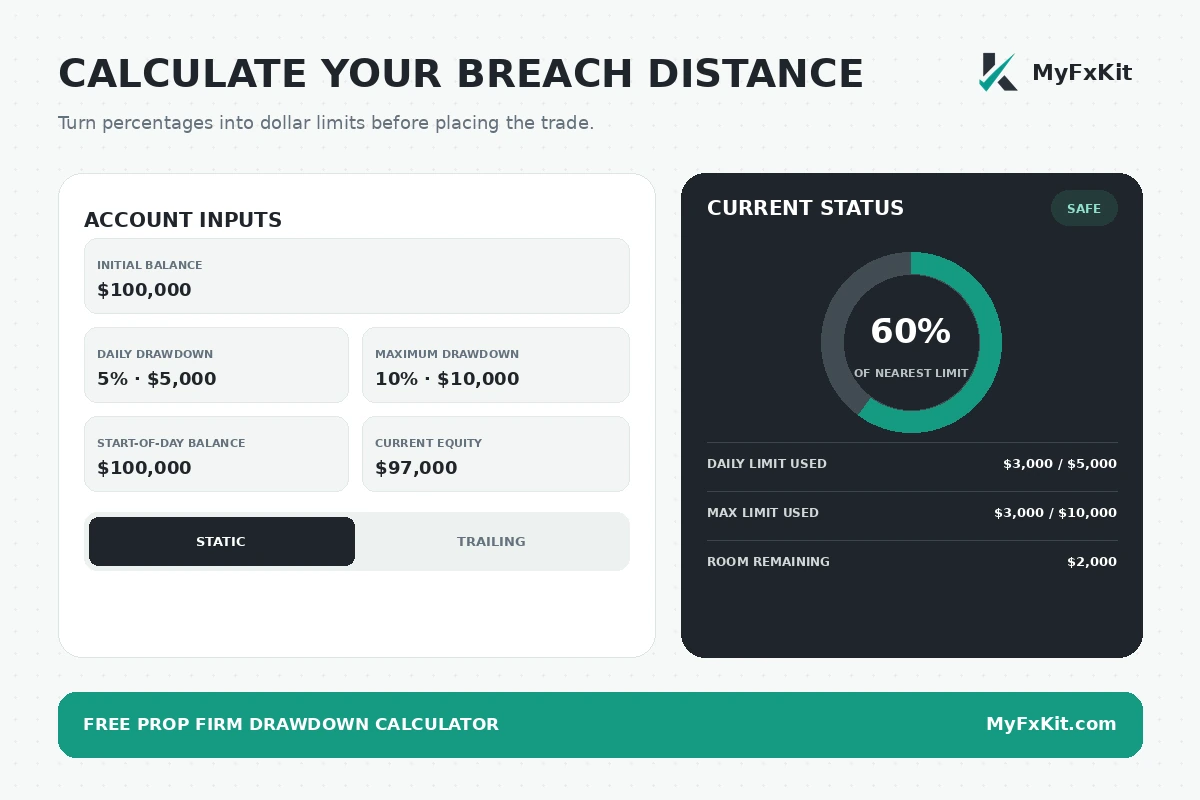
Convert drawdown percentages into dollar limits and see the remaining distance to the nearest breach level.
Why you should not trade down to the final dollar
If the calculation shows $300 of remaining room, the account does not have $300 of genuinely safe trading capacity. Equity can move lower because of:
- Sudden spread expansion
- Slippage during news or a market open
- Entry and exit commissions
- Swap and overnight financing charges
- Simultaneous movement across correlated positions
- Weekend gaps
The MyFxKit live spread page can help compare current symbol conditions, but neither live nor historical data guarantees the execution cost of the next order. Define a personal buffer above the contractual floor. Repeatedly trading with 95% to 100% of a loss limit used leaves the account exposed to a minor cost or price movement.
Common prop firm drawdown mistakes
- Treating daily and maximum drawdown as one rule: They are separate limits.
- Watching only balance: Floating loss may already have pushed equity through the floor.
- Assuming the reset follows local midnight: Use the time shown by the firm or dashboard.
- Ignoring today’s closed profit and loss: Some daily formulas measure the net result of the current trading day.
- Treating all trailing models as identical: The high-water mark, dollar distance, update frequency and lock level can differ.
- Comparing firms instead of specific programs: Two account types sold by one firm may use different rules.
- Planning to trade exactly to the breach level: Execution costs and short-lived volatility require a buffer.
See the MyFxKit prop firm rules hub for other limits that can affect an otherwise profitable account. The MyFxKit methodology explains how comparison data and the TC Score are structured.
Frequently asked questions
Does hitting the exact drawdown level count as a breach?
MyFxKit calculations treat an account that exactly reaches the defined floor as being at the breach point. Zero remaining room is not usable trading space. Firm wording can differ, however: some contracts say “touches,” while others say “below” or “exceeds.” Apply the exact language and measurement method of the selected program when evaluating a real account.
Does profit from the previous day increase today’s daily limit?
It can raise today’s reference floor when a program calculates the limit from start-of-day balance or equity. Other programs keep the dollar allowance tied to the initial account size. The treatment of profit earned during the current day also varies, so use the program’s formula rather than assuming every daily limit works the same way.
Can an open trade breach a prop firm account?
Yes, when the firm monitors equity or floating loss. A position may later recover and close profitably, but a momentary breach can still be recorded while the trade is open.
Is trailing drawdown always harder than static drawdown?
Trailing drawdown usually reduces how much profit can be given back after an account grows, but the difficulty depends on what the firm trails, when the floor updates and where it stops. A wider percentage is not automatically easier if the reference method is more restrictive.
Does the MyFxKit calculator replace the firm’s official rules?
No. The calculator converts percentages into dollar levels and helps test scenarios. Prop firm programs can change, and comparison data may update later than the firm’s own dashboard or contract. Always confirm the output against the official rules for the exact account.
Calculate the real limits on your account
A drawdown percentage becomes useful only after it is converted into a dollar allowance and breach level. Enter the account balance, daily percentage, maximum percentage and drawdown model in the free MyFxKit prop firm drawdown calculator to see the loss allowances, breach floor and current distance to the nearest limit.