
Propia vs SGB: Which Prop Firm Fits Your Strategy?
Compare Propia Master and SGB Plan A at $10K across targets, drawdown, trading restrictions, payouts, fee refunds and trader fit.
Contents
- Propia vs SGB: the quick verdict
- Propia Master vs SGB Plan A table
- The same entry fee does not mean the same cost
- Targets and time pressure
- Drawdown comparison
- The rules create different risk bottlenecks
- Propia's 40% phase-profit distribution rule
- SGB's 3% simultaneous-risk cap
- Fast scalping, EAs and VPS use
- News trading and weekend holding
- Payout timing: active days versus trading days
- Fee-refund comparison
- Access and payments for Iranian traders
- Platform and trading costs
- Where Propia is stronger in this comparison
- Where SGB is stronger in this comparison
- Which programme fits which trader?
- Pre-purchase checklist
- Final verdict
- Frequently asked questions
- Which $10K challenge is cheaper?
- Which programme has easier profit targets?
- Which programme provides more drawdown?
- Which programme is better for an EA?
- Which programme is better for weekend holding?
- Which firm returns the challenge fee earlier?
- Do both firms accept Iranian traders?
- When was this comparison researched?
- Sources reviewed
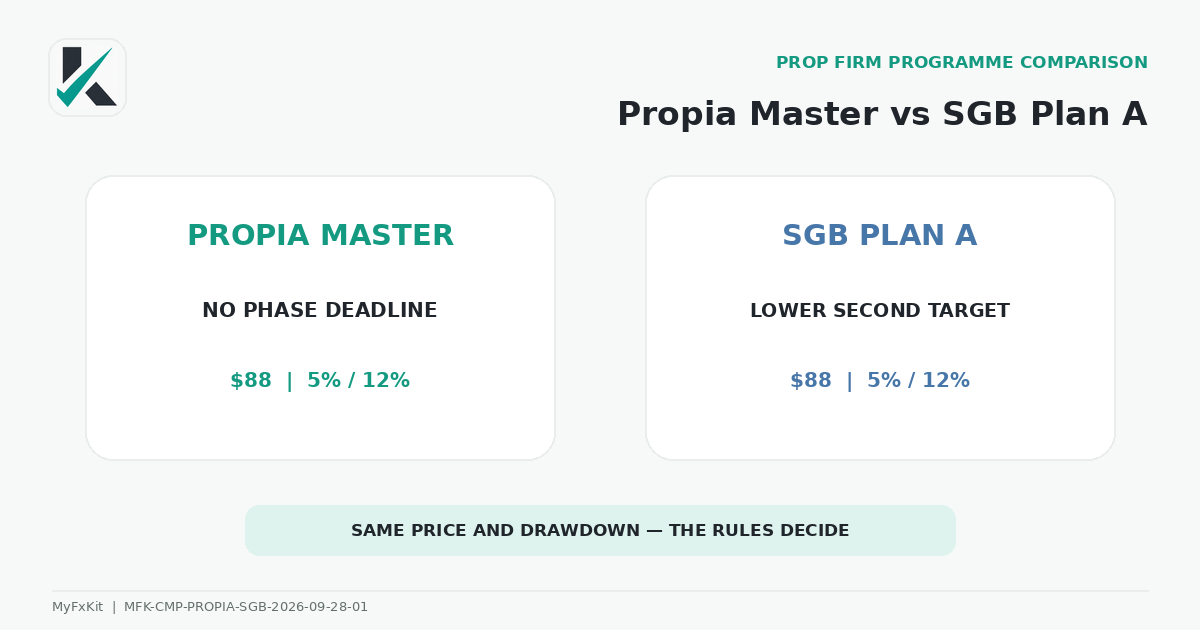
A useful Propia vs SGB comparison needs to place genuinely comparable programmes side by side. This review compares the two-step Propia Master with SGB Plan A at the $10,000 account size. At the time of research, both had an $88 base fee, an 8% phase-one target, 5% daily drawdown, 12% fixed maximum drawdown and an 80% starting trader share.
Those matching headline figures do not make the programmes interchangeable. Propia has the higher phase-two target, but no stated phase-completion deadline and fewer minimum trading days. SGB has a lower second target, but applies 30-day and 60-day deadlines, a separate simultaneous-risk cap and restrictions on automated trading and VPS use. SGB includes overnight and weekend holding in the standard rules, while Propia sells that permission as an add-on.
Author: MyFxKit Content Team
Technical review: MyFxKit Technical Team
Sources checked: September 28, 2026
Snapshot ID: MFK-CMP-PROPIA-SGB-2026-09-28-01
This comparison is not financial advice and does not guarantee that a trader will pass an evaluation or receive a reward. Prices, product availability and rules can change. The checkout page, agreement and account-specific rules in force on the purchase date remain the final reference.
Propia vs SGB: the quick verdict
- Propia Master is the stronger first option for traders who want no phase deadline, prefer a three-day minimum and need a route for a registered EA.
- SGB Plan A is the stronger first option for traders who prioritise a 4% second-phase target, standard weekend holding and earlier fee recovery.
- Both $10K programmes displayed an $88 base price, an 8% phase-one target, 5% daily drawdown, 12% fixed maximum drawdown and an 80% initial share.
- Propia applies a 40% phase-profit distribution rule and asks buyers to choose between an EA route with the 60-second rule or removal of the 60-second rule without an EA.
- SGB applies a separate 3% cap to one trade or the combined loss on simultaneously open trades, plus a rule governing profits from winning trades held for less than 30 seconds.
- Treat an exact touch of a drawdown floor as a breach in either programme and leave room for spread, commission and slippage.
Propia Master vs SGB Plan A table
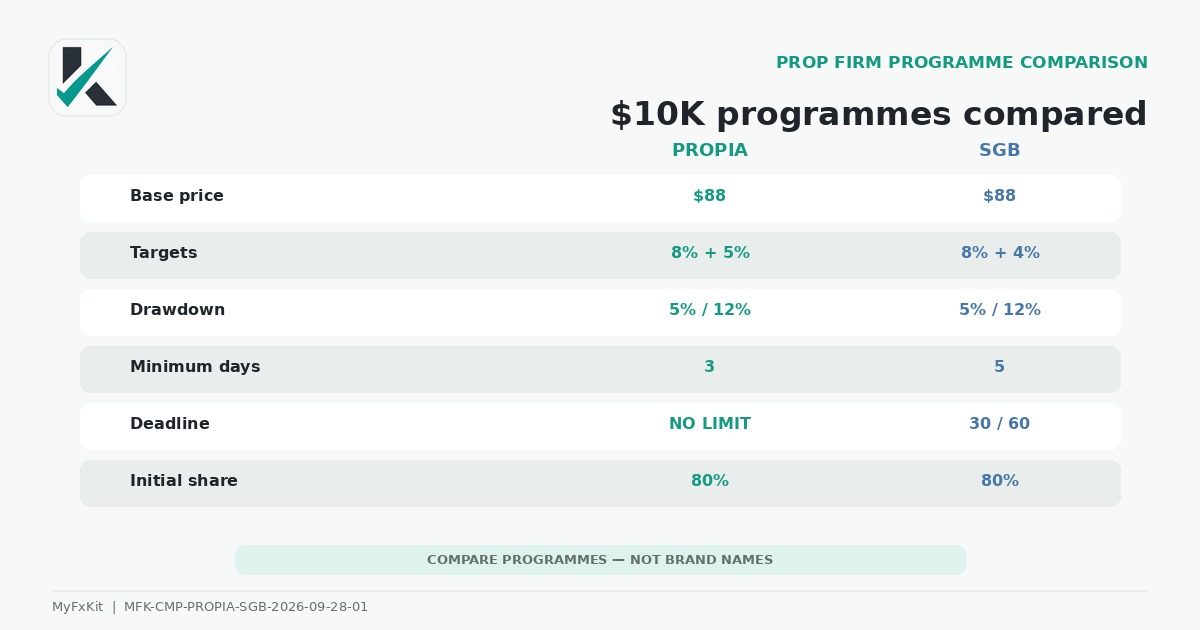
| Feature | Propia Master | SGB Plan A |
|---|---|---|
| Compared account size | $10,000 | $10,000 |
| Base price when checked | $88 | $88 |
| Evaluation phases | 2 | 2 |
| Phase-one target | 8% | 8% |
| Phase-two target | 5% | 4% |
| Daily drawdown | 5% | 5% |
| Maximum drawdown | 12% fixed | 12% fixed |
| Minimum trading days | 3 per phase | 5 per phase |
| Phase deadline | None stated | 30 and 60 calendar days |
| Initial trader share | 80% | 80% |
| Stated maximum share | 95% with add-on | 85% from month three |
| First payout request | After 20 active days | After three weeks and 7 trading days |
| Later payout cycle | 14 active days | Every two weeks |
| News trading | Allowed; news bracketing prohibited | Allowed |
| Overnight and weekend holding | Swing add-on required | Allowed |
| Expert adviser | Conditional and registered | Prohibited |
| VPS | Confirm the selected route and setup | Prohibited |
| Separate simultaneous-risk cap | No published percentage cap | 3% on the $10K account |
| Fast-trade rule | 60-second route or removal without EA | Profit test on sub-30-second trades |
| Platform | MT5 | MT5 |
The $88 figures are base prices, not temporary promotional prices. Propia add-on fees are not included. Record the final checkout amount and every selected option before paying.
The same entry fee does not mean the same cost
An equal $88 price makes the initial comparison unusually clean, but it does not equalise the effective cost. Propia's Swing + No-Swap add-on increases the purchase price by 20%. Selecting the 95% trader share adds 35%. SGB Plan A includes weekend holding in its standard rules, but its stated share rises only to 85% from the third month.
If a trader does not need weekend holding and is satisfied with the standard 80% share, the programmes begin at the same price. If weekend holding is essential, Propia becomes more expensive. If the priority is a 95% share, the add-on cost must be weighed against SGB's slower route from 80% to 85%.
A discount should never substitute for rule compatibility. One cheap attempt on an unsuitable programme may create a higher real cost than a more expensive attempt that fits the trading record. The MyFxKit challenge-cost guide explains how to compare entry fees, repeat attempts and fee refunds.
Targets and time pressure
Both programmes require 8% in phase one. On a $10K account:
Phase-one target = $10,000 × 8% = $800
The difference appears in phase two:
Propia phase-two target = $10,000 × 5% = $500
SGB phase-two target = $10,000 × 4% = $400
SGB therefore asks for one percentage point less across the second phase. Plan A, however, limits phase one to 30 calendar days and phase two to 60 calendar days. Propia states no final deadline for reaching the target and requires three minimum trading days per phase; SGB requires five.
SGB is easier only when measured by the second target. For a low-frequency strategy or one that regularly waits through unsuitable market conditions, Propia's lack of a deadline may matter more than the $100 difference between the second-phase targets. A trader who normally completes evaluations in several weeks may benefit more from SGB's 4% target.
Drawdown comparison
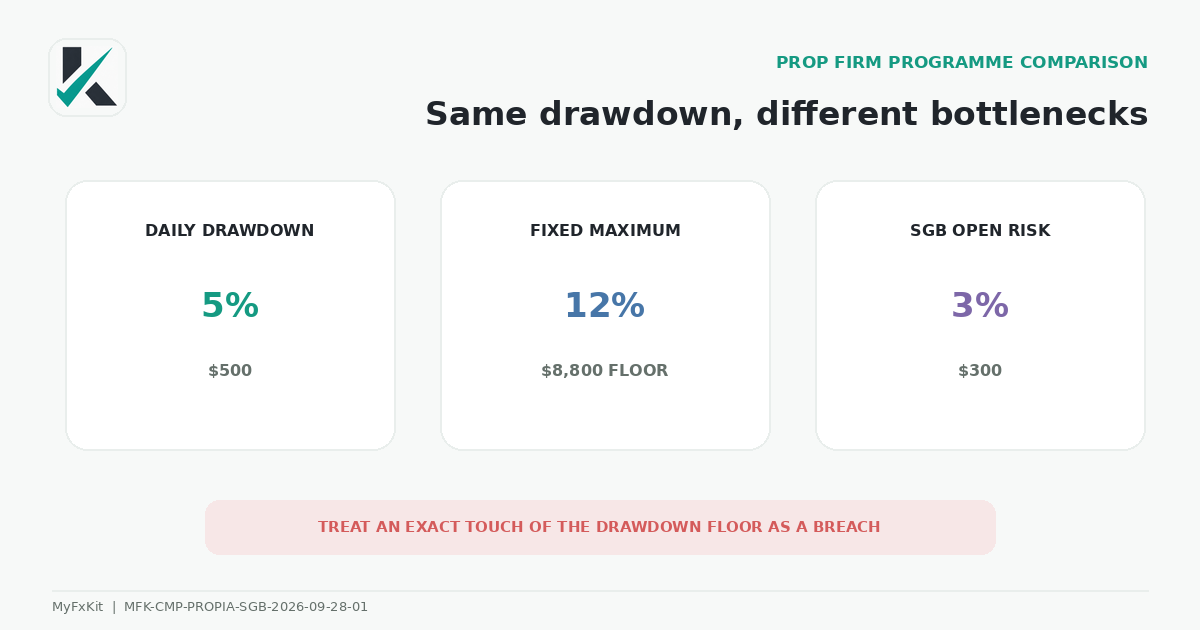
Both programmes state 5% daily drawdown and 12% fixed maximum drawdown. On a $10K account:
Nominal daily-loss allowance = $500
Maximum-drawdown floor = $10,000 − $1,200 = $8,800
The matching percentages are significant, but the exact daily formula and reset time must still be confirmed for the purchased account. SGB describes the daily floor as based on the balance at midnight server time and treats touching the floor as a violation. Propia requires both balance and equity to remain above the relevant boundary and also treats an exact touch as a breach.
Do not purchase either programme based only on the phrase “5% daily and 12% total.” An open position can touch the threshold through changes in equity, spread, commission or a market gap. Test your scenario with the drawdown calculator and review fixed versus trailing floors in the prop firm drawdown guide.
The rules create different risk bottlenecks
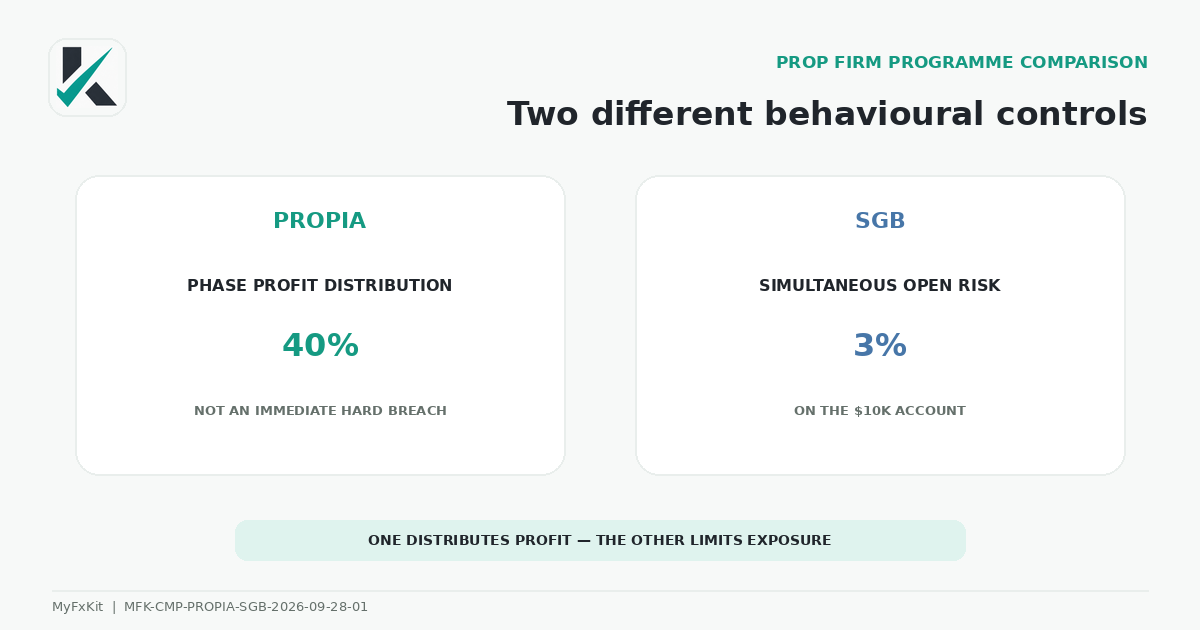
The published drawdown percentages match, but the second layer of control is designed differently.
Propia's 40% phase-profit distribution rule
During the Propia evaluation, gross profit from winning trades on one calendar day is compared with the target for that phase. On a $10K Master account with an $800 target:
40% × $800 = $320
If eligible winning-trade profit for one day exceeds $320, that fact alone is not described as an immediate hard breach. During phase review, the amount outside the formula is removed from the result eligible for approval. If the adjusted balance still reaches the target, the phase can be approved; if it does not, the account remains active and the trader must complete the remaining distance.
This rule matters to traders whose results are concentrated in one or two strong sessions, even if their drawdown is low. The consistency-rule guide explains the difference between distribution tests, hard caps and payout conditions.
SGB's 3% simultaneous-risk cap
On the $10K SGB Plan A account, the loss on one position or the combined loss on all simultaneously open positions must remain within 3% of current balance. At a $10,000 balance, the nominal boundary is $300.
This is separate from the $500 daily drawdown allowance. A trader can close one loss and open a later trade while preserving the remaining daily budget, but cannot allow the combined floating loss on open positions to cross the 3% threshold. For a multi-position strategy, this restriction may become active before daily drawdown. The floating-loss rule guide covers overlapping-position scenarios.
Fast scalping, EAs and VPS use
Propia presents two main purchase routes: an EA route with the 60-second rule, or removal of the 60-second rule without an EA. An EA used on the post-evaluation account must be registered and approved. Removing the 60-second condition does not permit arbitrage, HFT, tick scalping, stacking, news bracketing or third-party trade copying.
SGB states that automated trading robots and VPS use are prohibited. A risk-management utility may be treated differently from an automated execution robot, but the distinction should be confirmed in writing. Copying arrangements are also allowed only under published identity and technical conditions.
SGB's fast-trade rule focuses on profit from winning trades closed in less than 30 seconds. If the combined amount exceeds 20% of the phase target or withdrawable reward, the account can be reset. For phase one on a $10K account with an $800 target:
20% × $800 = $160
Anyone whose average holding time sits close to either 30 or 60 seconds should not rely on a generic “scalping allowed” statement. Examine one to three months of actual trade history: how many positions closed below each time threshold, and how much of the total profit came from them?
News trading and weekend holding
Both firms describe news trading as allowed, but neither permits exploitative use of stale prices, arbitrage or coordinated execution. Propia specifically prohibits news bracketing and coordinated hedging around an event. SGB warns that slippage and abnormal market conditions remain relevant.
SGB allows overnight and weekend holding in both plan families. It nevertheless prohibits order activation on Saturday and Sunday while global markets are closed, including on crypto.
Propia's standard account is intraday. Overnight or weekend holding requires the Swing + No-Swap add-on, selected during purchase at a 20% price increase. The add-on does not remove reopening-gap risk or the effect of equity on drawdown. See the weekend-holding guide before selecting either route.
Payout timing: active days versus trading days
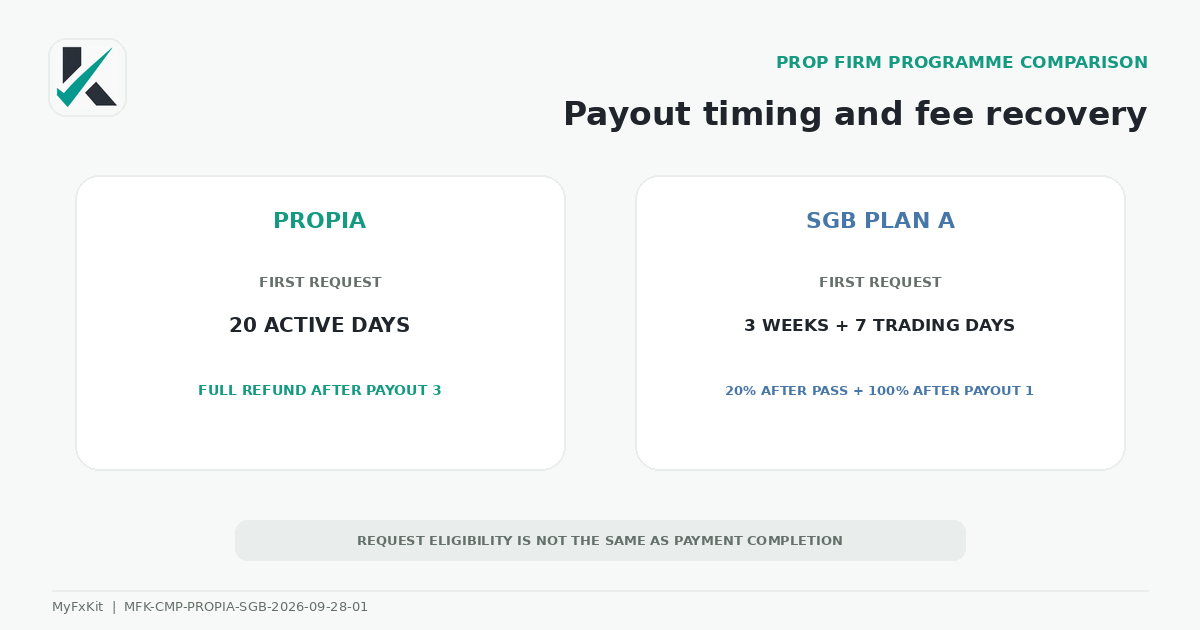
Propia states that the first request becomes available after 20 active days and later requests after 14 active days. The base trader share is 80%; a 95% add-on can be selected at purchase. Rewards are paid in USDT, and the recorded policy applies a $5,000 gross-profit settlement cap to each payout event.
SGB Plan A makes the first payout available after at least three weeks from the first trade on the funded-stage account and at least seven trading days. The trader share is 80% during the first two months and can rise to 85% from the third month. Later requests are available every two weeks.
“Twenty active days” is not automatically the same as 20 calendar days. Likewise, seven trading days does not mean seven days from account delivery. The definition of a qualifying day and the start of each count can materially change the real first-payout date. The payout guide for Iranian traders separates eligibility, approval and final transfer.
Fee-refund comparison
SGB publishes a nominal 120% structure: 20% of the fee after successfully completing both phases and 100% after the first payout. The 20% portion must be requested inside the stated window after receiving the funded-stage account; the version reviewed specified 45 days.
Propia states that 100% of the challenge fee becomes eligible for refund after the third approved payout event. It also allows a remorse refund within five calendar days of purchase if no trade has been placed. Processing or transfer fees may be deducted.
SGB therefore offers earlier fee recovery on paper, while Propia moves the full challenge-fee refund to the third approved payout. Neither should be treated as guaranteed cash. Passing, remaining compliant, satisfying the payout conditions and submitting a valid request are prerequisites.
Access and payments for Iranian traders
Both firms are recorded in the current MyFxKit directory as accepting Iranian traders and both publish Persian-language material. SGB states that it accepts local-currency and crypto payments. Propia's public route uses USDT for rewards and supports crypto payment flows.
Nationality is not the only eligibility variable. Country of residence, IP location, proof of address, payer name and payout destination must comply with the current policy. Before paying, obtain a written answer that includes both your nationality and actual country of residence. A generic statement that “Iranian traders are accepted” may not resolve a residence, document or payment-method issue. Use the prop firms for Iranian traders guide as a KYC and payment checklist.
Platform and trading costs
Both firms provide MT5. The same platform does not produce identical execution. Spread, commission, swap, contract size, server time, stop level and slippage should be checked on the instruments and sessions used by the strategy.
The MyFxKit record at the time of review showed a $4.50 commission per lot and approximately 3.20 gold spread for SGB. Propia's target conditions stated a $4 commission per lot for forex, metals, commodities and indices, with gold spread starting around 1.8 pips and a target cap of 4 pips. These are not guarantees of a fixed spread or fill. Recheck them on the live spread board and on the exact account product.
Where Propia is stronger in this comparison
- No stated deadline for completing either Master phase.
- Three minimum trading days per phase rather than five.
- A conditional route for a registered EA.
- No separate published 3% simultaneous-risk percentage cap.
- An optional 95% trader share.
- The same 8% phase-one target and fixed 12% maximum drawdown as SGB Plan A.
Where SGB is stronger in this comparison
- A 4% phase-two target rather than 5%.
- Overnight and weekend holding without a separate add-on.
- A stated 20% fee return after passing and 100% after the first payout.
- A route from 80% to 85% without buying a profit-share add-on.
- Local-currency payment alongside crypto.
- A clearly published simultaneous-risk threshold for controlling exposure.
Which programme fits which trader?
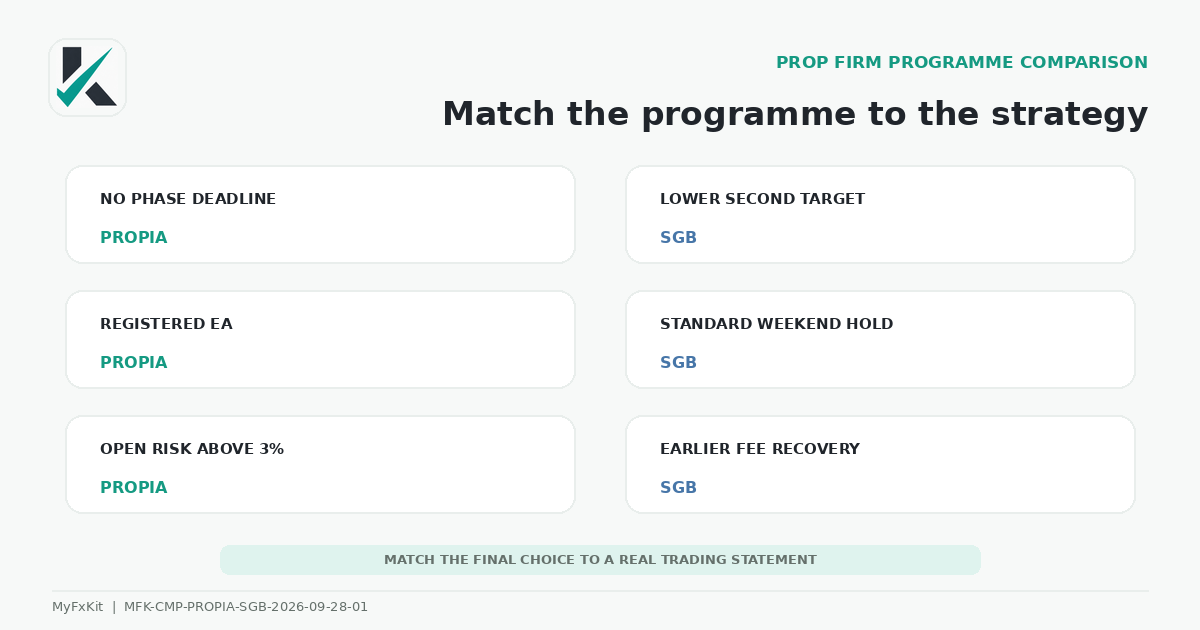
| Priority or strategy | First programme to examine | Main reason | Main caution |
|---|---|---|---|
| No phase deadline | Propia Master | No stated completion deadline | 40% distribution rule |
| Lower second target | SGB Plan A | 4% rather than 5% | 60-day phase-two deadline |
| Personal EA | Propia | Registered-EA route | 60-second condition on EA route |
| VPS is essential | Propia after written confirmation | SGB explicitly prohibits VPS use | Technical setup must be approved |
| Weekend holding | SGB | Included in the standard rules | Gap and slippage risk |
| Multiple simultaneous positions | Propia | No published 3% SGB-style cap | Drawdown and other rules still apply |
| Profit concentrated in one day | SGB with caution | Propia's 40% rule may restrict approval | SGB fast-trade and 3% risk rules |
| Sub-30-second scalping | Neither without statement analysis | Both have speed-related restrictions | Calculate the fast-profit share |
| Earlier fee refund | SGB | Part after passing; remainder after first payout | Do not miss the request window |
| 95% trader share | Propia | Available as an add-on | 35% fee increase |
This table is not an automatic verdict. A trader who needs both an EA and weekend holding, for example, must compare the cost and terms of Propia's selected add-ons with SGB's prohibition on automated trading.
Pre-purchase checklist
- Confirm that the product is specifically Propia Master or SGB Plan A; the brand name alone is not enough.
- Save the base price, discount and add-on cost from checkout on the purchase date.
- Save the rules and agreement as a dated PDF or screenshot.
- Verify the daily reset time inside MT5.
- On SGB, keep combined open risk below the 3% threshold.
- On Propia, compare gross winning-trade profit per day with 40% of the phase target.
- Calculate how much actual profit came from trades held for less than 30 or 60 seconds.
- Confirm the EA, VPS, copier, IP and device setup in writing.
- Put active days, trading days and calendar days into separate payout calculations.
- Confirm nationality, residence, KYC documents, payment method and USDT network before purchasing.
Final verdict
At the $10K level, Propia Master and SGB Plan A share four major headline figures: an $88 base fee, an 8% phase-one target, 5% daily drawdown and 12% fixed maximum drawdown. The real decision is between Propia's time flexibility and tool options and SGB's lower second target, standard weekend holding and earlier fee recovery.
Propia Master is the more natural first candidate for a low-frequency trader, a registered-EA user or anyone unwilling to trade under a phase deadline. SGB Plan A may fit a discretionary trader who normally completes evaluations within several weeks, wants weekend holding and can operate inside the 3% simultaneous-risk limit.
There is no universal winner. The better programme is the one whose restrictions match a real trading statement. For the detailed profile of each firm, read the Propia review and SGB review, then recheck the current data on the Propia profile and SGB profile.
Frequently asked questions
Which $10K challenge is cheaper?
When checked, Propia Master and SGB Plan A both displayed an $88 base fee. Propia add-ons and temporary promotions can change the final checkout amount.
Which programme has easier profit targets?
Both require 8% in phase one. SGB requires 4% in phase two compared with Propia's 5%, but SGB also has phase deadlines and more minimum trading days.
Which programme provides more drawdown?
The compared products both state 5% daily drawdown and 12% fixed maximum drawdown. Their practical difference lies in SGB's simultaneous-risk cap and Propia's profit-distribution rule.
Which programme is better for an EA?
Propia provides a route for a registered EA with the 60-second condition. SGB states that automated trading robots are prohibited.
Which programme is better for weekend holding?
SGB includes overnight and weekend holding in the standard rules. Propia requires the Swing + No-Swap add-on at an increased price.
Which firm returns the challenge fee earlier?
Under the published structures, SGB returns part after passing and the main portion after the first payout. Propia ties the full challenge-fee refund to the third approved payout.
Do both firms accept Iranian traders?
Both are currently recorded by MyFxKit as accepting Iranian traders. Residence, KYC, IP location and payment method still need separate confirmation before purchase.
When was this comparison researched?
The official sources and current MyFxKit records were checked on September 28, 2026. The snapshot ID is MFK-CMP-PROPIA-SGB-2026-09-28-01.
Sources reviewed
Update history: First edition published from the September 28, 2026 snapshot, comparing price, targets, drawdown, deadlines, fast-trade rules, EA permissions, weekend holding, payouts and fee recovery.
Further reading
- PropiaFunds vs FundedNextCompare PropiaFunds and FundedNext on 50K two-step pricing, targets, drawdown, platforms, payouts, trading rules and country access.
- PropiaFunds vs FTMOCompare PropiaFunds Master and FTMO 2-Step on targets, drawdown, platforms, trading permissions, payouts, fees and country eligibility.