
Prop Firm Consistency Rule Explained
Learn how prop firm consistency rules work, compare 25%–50% limits, calculate the profit you need, and avoid payout or challenge surprises.
A prop firm consistency rule limits how much of the measured profit may come from one trading day. The idea sounds simple, but the calculation is not universal: one program may divide the best day by a phase target, another by total cycle profit, and another by the sum of profitable days.
That denominator changes the result. The same best day can pass one program, delay a payout in another, or keep an evaluation open in a third. Before calculating anything, identify the formula, the stage where it applies, and the consequence of exceeding the limit.
The consistency rule measures concentration: how much of the relevant profit figure came from the single best trading day.
Written by MyFxKit Content Team · Reviewed by MyFxKit Technical Team
Rules verified: August 30, 2026. Prop firm terms change frequently. Recheck the official page for your exact program and reward cycle before trading.
What is a prop firm consistency rule?
A consistency rule is a profit-distribution condition. It compares the profit from your highest-profit trading day with a denominator defined by the program. The result shows whether one day contributed too large a share.
The general formula is:
Consistency score = Best trading day profit ÷ Defined denominator × 100For example, if the best day is $1,200 and the permitted share is 30%, the required denominator is:
Minimum required denominator = $1,200 ÷ 0.30 = $4,000Until the program’s defined denominator reaches $4,000, that $1,200 day represents more than 30%.
This rule is different from prop firm drawdown. Drawdown limits how far balance or equity may fall. Consistency limits how concentrated the profit may be. A trader can be safely above every drawdown floor and still be ineligible to pass or request a reward because of consistency.
The denominator is the most important part
Do not use one formula for every prop firm. First identify which of these three models the program uses:
| Model | Calculation | Effect of a losing day |
|---|---|---|
| Phase-target model | Best day ÷ phase profit target | Target stays fixed; the loss delays reaching it |
| Total-profit model | Best day ÷ current net cycle profit | Loss reduces the denominator and worsens the score |
| Positive-days model | Best day ÷ sum of profitable days | A negative day is excluded from this denominator |
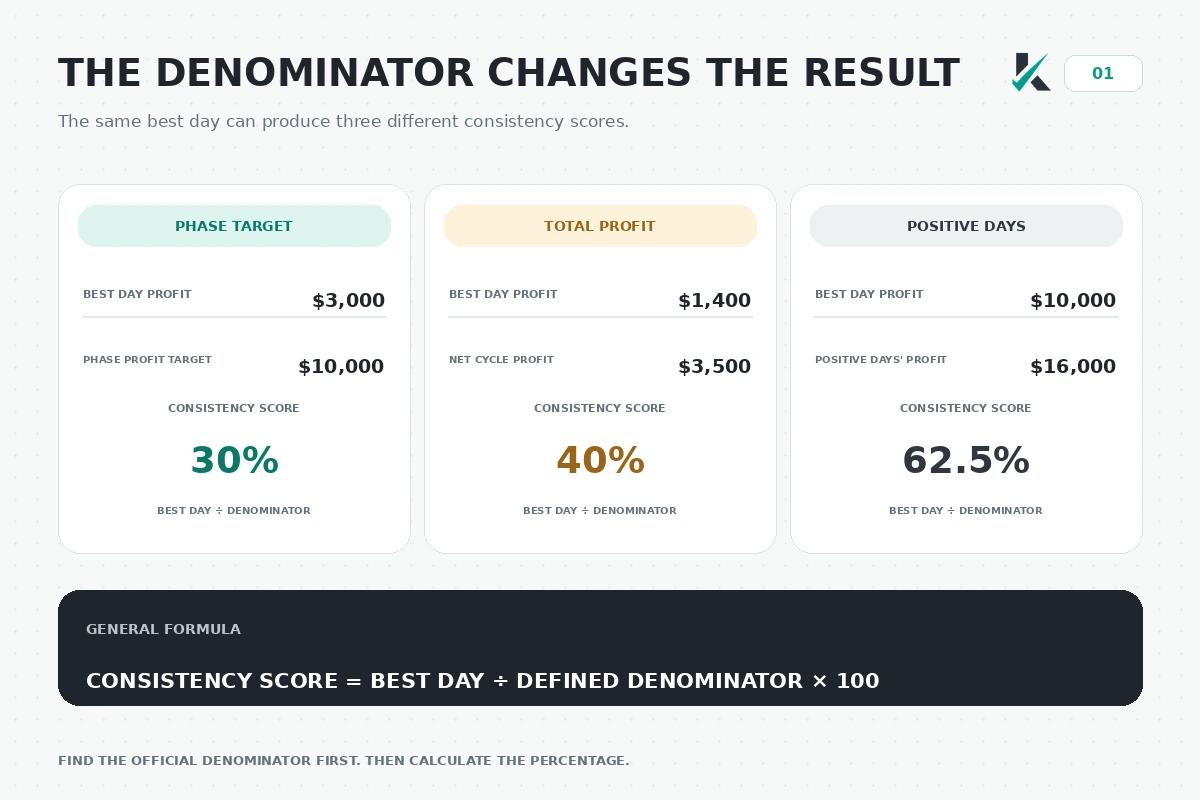
Find the denominator in the official rule first; only then calculate the percentage.
Phase-target model
This model turns a percentage of the phase target into a maximum best-day amount. If the target is $10,000 and the daily share limit is 30%:
Maximum best day = $10,000 × 0.30 = $3,000The current MyFxKit calculator uses this target-based model. Its denominator remains $10,000 even if the trader has currently earned less or has taken a losing day.
Total-profit model
Many reward-cycle rules divide the best day by total generated or net profit for that cycle. If the best day is $1,400 and total profit is $3,500:
$1,400 ÷ $3,500 × 100 = 40%Under a 35% rule, the trader is not yet compliant. The minimum total profit is $4,000, so another $500 is required if the best day does not increase.
Positive-days model
This model adds the results of profitable trading days and excludes negative days from that particular denominator. FTMO’s 1-Step Best Day Rule currently uses Positive Days’ Profit.
If the best day is $10,000 and Positive Days’ Profit is $16,000:
$10,000 ÷ $16,000 × 100 = 62.5%With a 50% ceiling, Positive Days’ Profit must reach at least $20,000. The trader therefore needs another $4,000 across positive days, assuming no new day exceeds the existing $10,000 best day.
How 25%, 30%, 40% and 50% rules compare
A lower percentage is more restrictive because the best day may represent a smaller part of the denominator.
For a $10,000 denominator:
| Consistency limit | Maximum permitted best day |
|---|---|
| 25% | $2,500 |
| 30% | $3,000 |
| 40% | $4,000 |
| 50% | $5,000 |
If the best day is already $1,200, the minimum denominator becomes:
| Consistency limit | Minimum required denominator |
|---|---|
| 25% | $4,800 |
| 30% | $4,000 |
| 40% | $3,000 |
| 50% | $2,400 |
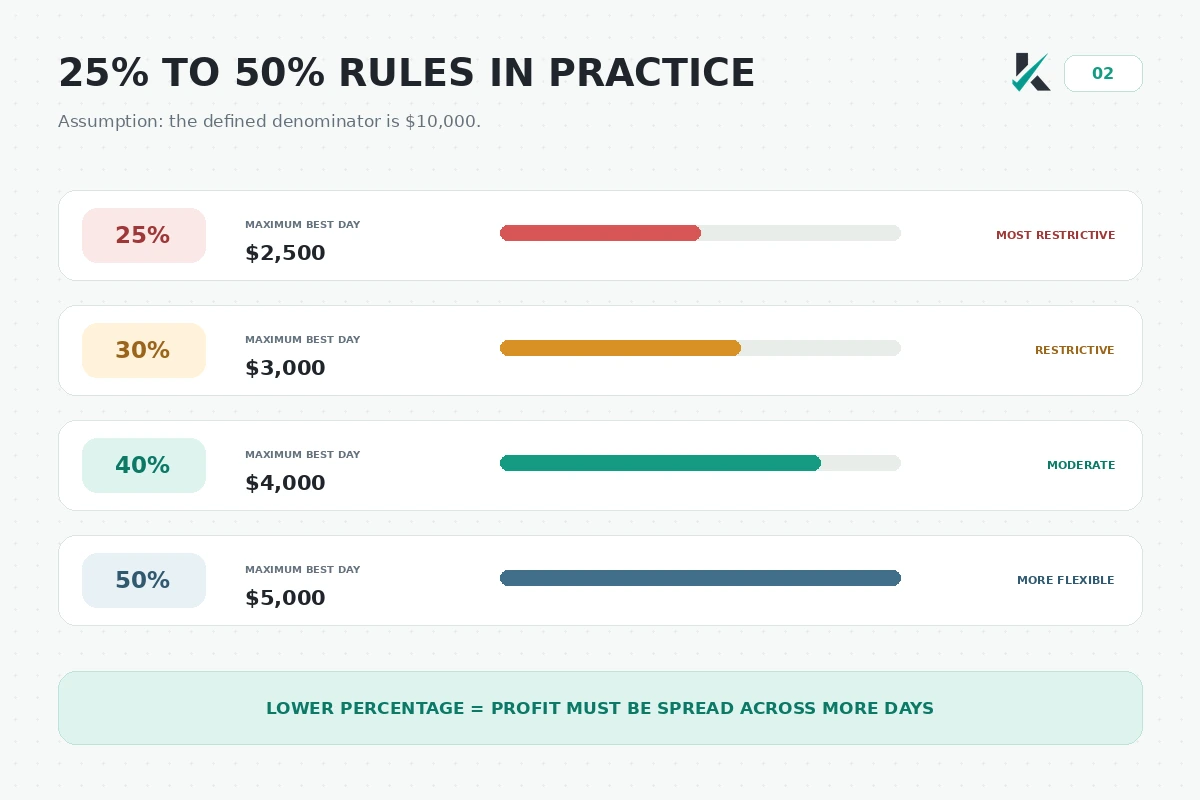
The smaller the allowed percentage, the more broadly the profit must be distributed.
How much additional profit do you need?
Use two steps when a best day is already known:
Minimum denominator = Best day ÷ Allowed percentage as a decimal
Additional profit required = Minimum denominator − Current denominator
Suppose your best day is $1,500, the rule is 30%, and the current denominator is $4,200:
Minimum denominator = $1,500 ÷ 0.30 = $5,000
Additional profit required = $5,000 − $4,200 = $800
This answer remains valid only if later daily profit stays below $1,500. If a new day becomes the best day, calculate again with the new numerator.
Is reaching the exact limit allowed?
There is no universal answer. The operator in the official wording controls the boundary.
- “Does not represent more than 50%” normally permits exactly 50%.
- “Must remain below 30%” excludes exactly 30%.
- “At or above 30% is a breach” also excludes exactly 30%.
The live MyFxKit calculator currently displays an exact 100% usage result as at the limit, with no headroom. That is a useful warning, not a substitute for the program contract. Rounding, commissions, server-day adjustments, or a small additional profit on the same day can move the result over the boundary.
Challenge, funded account and payout rules are not the same
The stage of enforcement determines what non-compliance means:
| Enforcement stage | Typical purpose | Possible outcome |
|---|---|---|
| Evaluation or challenge | Distribute profit before completing a target | Continue trading, remain incomplete, or fail if the contract says so |
| Funded account | Control performance throughout an account cycle | Warning, restriction, or account breach only when expressly stated |
| Reward or payout request | Test the best day against cycle profit | Request remains unavailable until the score improves |
The word consistency does not prove that exceeding the percentage instantly terminates an account. Classify the rule as an eligibility condition, a financial adjustment, or a hard account breach.
Soft limit or eligibility condition
With a soft limit, the account remains active. The trader continues until the denominator grows enough to reduce the best day’s share.
FTMO states that exceeding its 1-Step Best Day limit is not a rule breach. The trader must continue until the best day represents 50% or less of Positive Days’ Profit. FundingPips and FundedNext also publish reward-cycle examples in which the reward request remains unavailable until the percentage returns within the allowed limit.
Hard breach or defined financial consequence
Some contracts can specify phase failure, account termination, profit removal, or an invalid reward cycle. Never infer that consequence from the percentage alone. A 40% rule can be a payout-eligibility condition in one program and a much stricter rule in another.
Look for exact terms such as hard breach, account termination, profit deduction, reward eligibility, and continue trading on the official program page.
How losing days affect the consistency score
The answer depends entirely on the denominator.
When the denominator is net cycle profit
Assume a $1,200 best day and $4,000 total profit:
$1,200 ÷ $4,000 = 30%After a $500 losing day, total profit falls to $3,500:
$1,200 ÷ $3,500 = 34.29%The best day has not changed, but the score is worse because the denominator is smaller.
When the denominator is Positive Days’ Profit
Suppose the profitable days are $1,000 and $600. Positive Days’ Profit is $1,600, and the best day represents 62.5%. A separate $200 losing day does not change this denominator because it is not a profitable day. It can still reduce net account profit and move the account closer to its drawdown limits.
When the denominator is the phase target
The target remains fixed. A loss does not change a $10,000 target denominator, but it increases the profit that must be recovered and may increase drawdown risk.
If total profit is zero or negative, a net-profit consistency score is not useful for reward eligibility. The account must first return to profit.
Current official examples from prop firms
The following rules were checked against official sources on August 30, 2026. This table demonstrates different structures; it is not a ranking or recommendation.
| Program | Percentage and denominator | Where it applies | Published result of exceeding it |
|---|---|---|---|
| FTMO Challenge: 1-Step | 50% of Positive Days’ Profit | 1-Step Challenge and FTMO Account | Not an account breach; continue until the result is 50% or less |
| FundingPips 2 Step Pro, Monthly 100% | 35% of total profit | Eligible Master Account reward request | Reward eligibility condition; resets after a processed reward |
| FundingPips 2 Step Standard, On Demand and Monthly | 35% of total profit | Master Account reward request | Request blocked until compliant; Weekly and Bi-Weekly are excluded |
| FundedNext On-Demand Rewards Add-On | 40% of total generated profit | FundedNext Account reward request | Trading cycle extends until reward eligibility is restored |
Official sources: FTMO Trading Objectives, FTMO 1-Step introduction, FundingPips 2 Step Pro, FundingPips 2 Step Standard, and FundedNext On-Demand Rewards Add-On.
These examples show why data must be classified at the program and stage level, not only by brand. A firm can apply consistency to one challenge, account type, add-on, or reward cycle while excluding another. Review the current MyFxKit profiles for FTMO, FundingPips, and FundedNext, then confirm the exact program on its official page.
How to use the MyFxKit consistency calculator
The current MyFxKit consistency calculator is designed for a target-based daily cap.
- Enter the initial account size.
- Enter the phase profit-target percentage.
- Enter the profit from your best trading day.
- Select or enter the consistency percentage.
- Review the maximum best-day amount and percentage of the limit used.
- Compare the result with the denominator and boundary wording in the official rule.
For a $100,000 account with a 10% profit target and a 30% consistency limit:
Profit target = $100,000 × 10% = $10,000
Maximum best day = $10,000 × 30% = $3,000
A $2,700 best day uses 90% of the permitted amount. A $3,000 best day is exactly at the calculator limit with no headroom. A $3,100 best day uses 103.33% of that target-based limit.
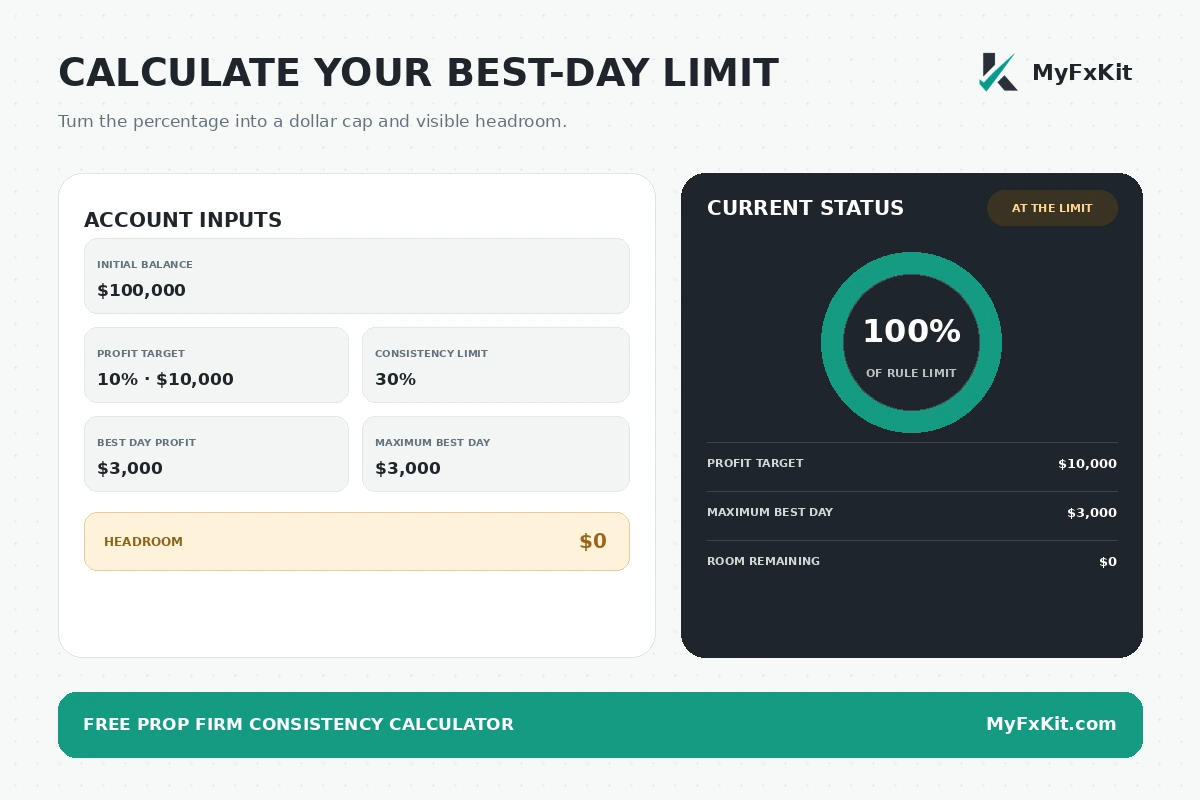
The calculator converts the percentage into a best-day dollar limit and visible headroom.
Do not substitute the phase target when a program uses total cycle profit or Positive Days’ Profit. Identify the official denominator and apply the matching formula alongside the tool result.
Common consistency-rule mistakes
- Always dividing by the target: some programs use net cycle profit or Positive Days’ Profit.
- Classifying an entire brand: a rule can apply only to one account, add-on, or reward cycle.
- Assuming every excess is a hard breach: many rules delay passing or reward eligibility instead.
- Ignoring losing days: a loss worsens the score when total net profit is the denominator.
- Adding several top days together: usually the numerator is one highest-profit day unless the rule defines another method.
- Ignoring the server-day boundary: the firm’s server time determines which closed trades belong to the same trading day.
- Trading exactly on the limit: rounding, commissions, and later trades leave no safety margin.
MyFxKit’s rule-verification process is explained in the editorial methodology. You can also review the prop firm rules hub before comparing account programs.
Frequently asked questions
How is a 30% prop firm consistency rule calculated?
Identify the denominator defined by the program, divide the best day by that number, and multiply by 100. If the denominator is $10,000, a 30% ceiling permits a best day of up to $3,000 only when the contract allows equality.
How much more profit do I need after exceeding the limit?
Divide the best day by the allowed decimal. A $1,500 best day under a 30% rule requires a denominator of at least $5,000. Subtract the current denominator to find the additional amount, then recalculate if a later day becomes the new best day.
Can one losing day ruin my consistency score?
It can worsen the score when net cycle profit is the denominator. A negative day normally does not enter a Positive Days’ Profit denominator, while a phase-target denominator remains fixed.
Does the consistency rule apply only during a challenge?
No. It can apply during an evaluation, on a funded account, only when requesting a reward, or at several stages. Always verify the exact program and cycle.
Is exactly reaching the consistency percentage a breach?
It depends on the wording. “More than 30%” normally allows exactly 30%; “30% or more” does not. Treat an exact-limit result as zero headroom even when equality is permitted.
Does the MyFxKit calculator replace the firm’s rules?
No. The calculator helps convert a target-based percentage into a dollar amount. The program’s official denominator, server-day definition, enforcement stage, and consequence remain authoritative.
Calculate your consistency-rule position
Enter your account size, phase target, best day, and permitted percentage in the free prop firm consistency calculator. Then compare the result with the exact denominator and enforcement wording for your program before taking another trade or requesting a reward.