
Prop Firms With No Time Limits
Compare verified prop firm challenges with no time limits, including minimum days, inactivity rules, drawdown models, targets and current fees.
A prop firm challenge with no time limit lets you complete the evaluation without a fixed expiry date. That does not mean every time-related rule disappears. A program may have no 30-day or 60-day deadline for reaching its profit target while still enforcing minimum trading days, an inactivity limit, and separate deadlines for identity verification or payouts.
MyFxKit reviewed eight exact CFD and Forex CFD programs for this guide—not merely eight brand names. Every program in the comparison had an official source explicitly stating that its evaluation duration was unlimited or had no time limit. Rules and displayed prices were captured on September 4, 2026 and should be checked again before purchase.
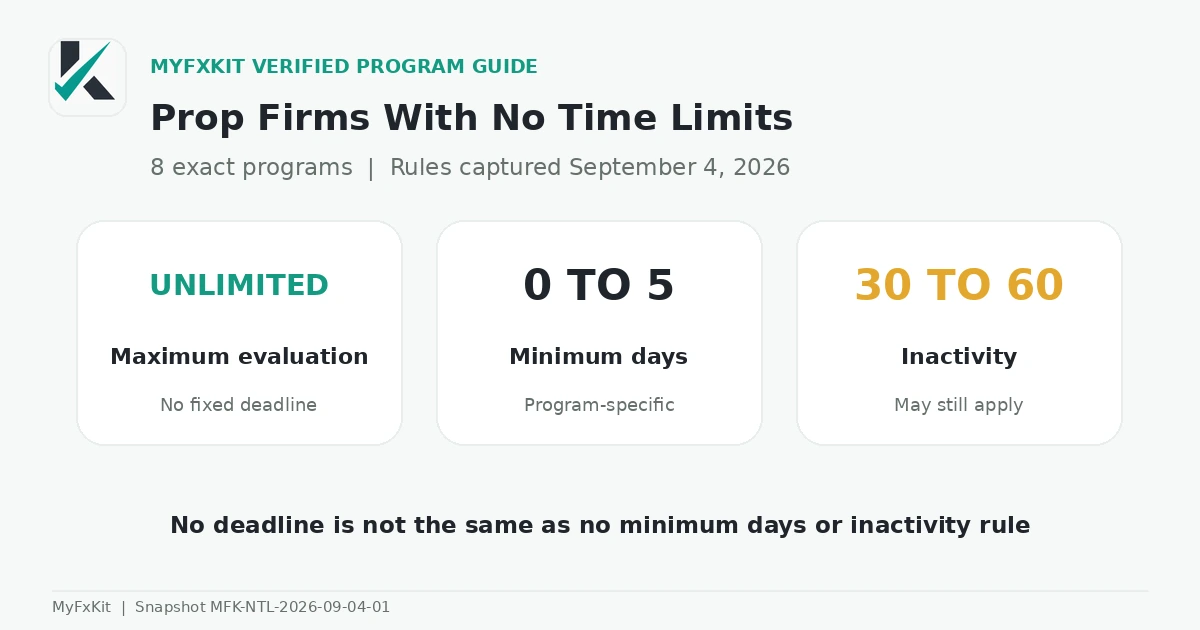
Quick answer: FTMO Challenge 1-Step, FTMO Challenge 2-Step, FundedNext Stellar 1-Step CFD, Stellar 2-Step CFD, Stellar Lite CFD, E8 Pro Forex, The5ers High Stakes New, and FundingPips 2 Step Standard met the inclusion test. No deadline automatically makes none of them easier, cheaper, safer, or more likely to pay. Drawdown mechanics, minimum days, inactivity requirements, and funded-stage rules still determine whether a program fits a trader.
Written by MyFxKit Content Team · Reviewed by MyFxKit Technical Team
Snapshot: MFK-NTL-2026-09-04-01 · Sources observed September 4, 2026. A machine-readable version is planned at the research dataset path. Fees are dated observations, not promises of future pricing. Discounts, taxes, currencies, account sizes, and checkout settings may change the final amount.
An unlimited evaluation period is not evidence about pass rates, execution quality, payout reliability, or company safety. This guide compares one program feature. It does not provide financial advice or guarantee an outcome.
What does a no-time-limit prop challenge mean?
In a challenge with a maximum duration, the trader must reach the profit target by a stated deadline. In a no-time-limit challenge, the maximum evaluation duration is unlimited. Provided no other rule is breached, failing to hit the target by day 30 or day 60 does not by itself end the account.
That definition removes only one clock. Three separate concepts must be recorded:
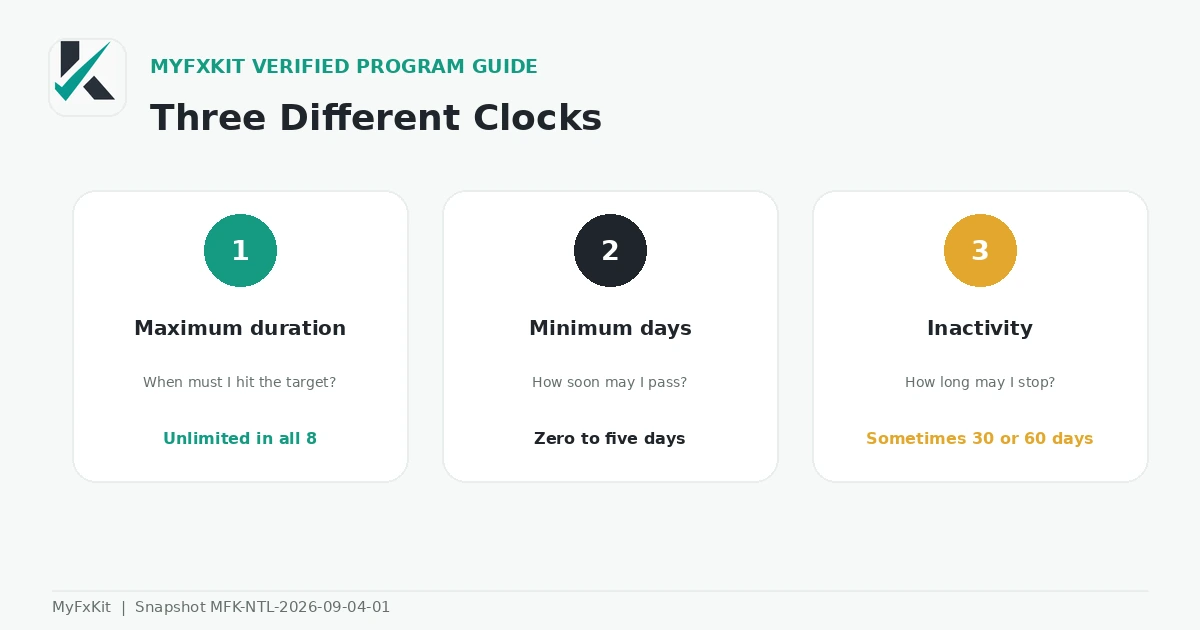
| Concept | Correct question | Practical effect |
|---|---|---|
| Maximum completion period | By what date must I hit the target? | Unlimited for every program in this list |
| Minimum trading days | What is the earliest date on which I may pass? | May be zero, two, three, four, or five days |
| Inactivity rule | How long may the account go without a qualifying trade? | The account may close despite having no completion deadline |
FundingPips 2 Step Standard illustrates the distinction. Its two phases have no maximum completion period, but each phase requires at least three trading days and at least one fully closed trade every 30 days. A trader may take six months to reach the target, but cannot leave the account without qualifying activity for 31 days.
How programs qualified for this list
The unit of analysis is:
brand + exact program + market + evaluation structure
A program qualified only when an official product page or help center explicitly confirmed no maximum evaluation deadline. Vague sales wording, third-party reviews, and the simple absence of a “Trading Period” row were not enough. We then recorded minimum days, inactivity, profit targets, daily loss, maximum loss, drawdown type, and the displayed fee for a reference $100,000 configuration.
The official FundedNext CFD product page places its current CFD challenges under a no-time-limit statement. To avoid treating a brand-level message as a complete ruleset, each included Stellar program was then matched with its exact official rule page. See the MyFxKit methodology for the broader source hierarchy and conflict-handling process.
The following did not qualify for this edition:
- A program whose funded account was unlimited but whose evaluation still expired.
- Futures programs, instant accounts, or customized add-ons that were not comparable with the standard CFD challenges.
- Discontinued programs or products whose unlimited-duration claim could not be verified officially.
- Checkout promotions that could not be captured for the same reference account size.
Comparison table: prop firms with no time limits
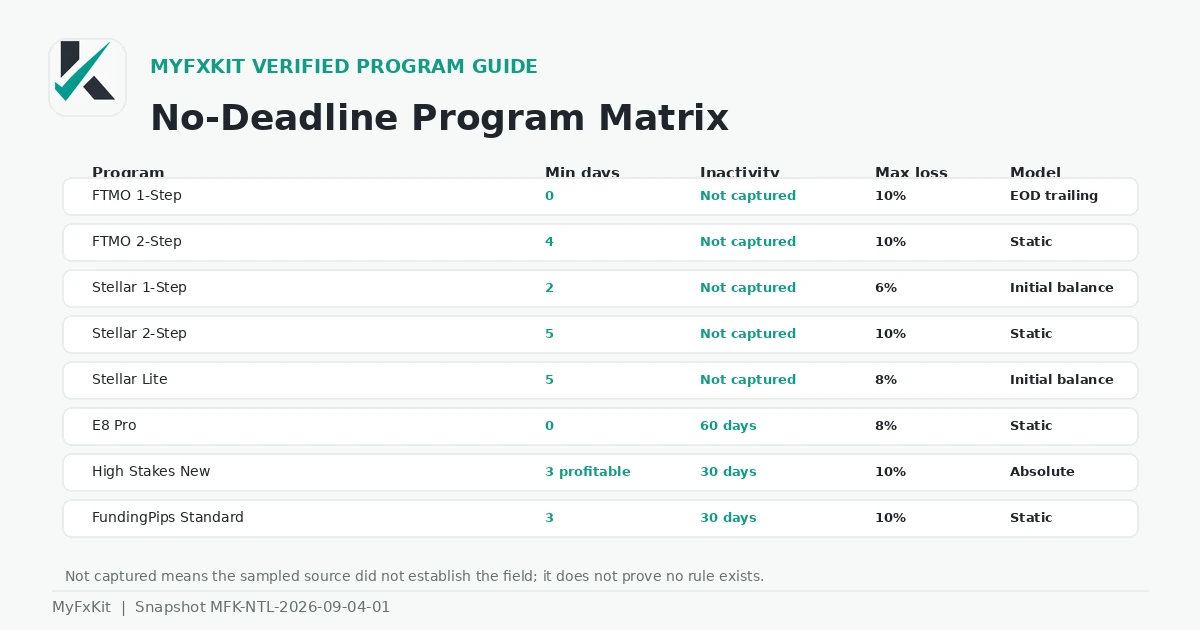
| Exact program | Completion time | Minimum days | Evaluation inactivity | Targets | Daily loss | Maximum loss | Drawdown model | Observed 100K fee |
|---|---|---|---|---|---|---|---|---|
| FTMO Challenge 1-Step | Unlimited | None | Not established in sampled source | 10% | 3% | 10% | End-of-day trailing | From €399 |
| FTMO Challenge 2-Step | Unlimited | 4 trading days | Not established in sampled source | 10% and 5% | 5% | 10% | Static | From €439 |
| FundedNext Stellar 1-Step CFD | No time limit | 2 trading days | Not established in sampled source | 10% | 3% | 6% | Initial-balance based | Publication-day capture required |
| FundedNext Stellar 2-Step CFD | No time limit | 5 trading days | Not established in sampled source | 8% and 5% | 5% | 10% | Static | $549.99 |
| FundedNext Stellar Lite CFD | No time limit | 5 trading days | Not established in sampled source | 8% and 4% | 4% | 8% | Initial-balance based | Publication-day capture required |
| E8 Pro Forex | Unlimited | None | 60 days | 8% | 2.5% | 8% | Static | $408 |
| The5ers High Stakes New | Unlimited | 3 profitable days | 30 days | 10% and 5% | 5% | 10% | Absolute, initial-balance based | Checkout capture required |
| FundingPips 2 Step Standard | No time limit | 3 trading days | 30 days | 8% and 5% | 5% | 10% | Static | Checkout capture required |
“Not established in sampled source” does not mean “no rule.” Silence in a selected page does not create negative evidence. FTMO also displayed higher reference prices beside the amounts observed in this snapshot, so “from” is retained rather than presenting a temporary offer as a permanent fee.
Program-by-program findings
FTMO Challenge 1-Step
The official FTMO 1-Step page lists its trading period as unlimited. The program has no minimum trading-day requirement, with a 10% target, 3% daily loss limit, and 10% maximum loss limit. However, maximum loss uses an end-of-day trailing structure and the program applies a 50% Best Day rule.
This combination demonstrates why “no deadline” does not mean “easy.” The trader gains time, but an increase in account balance can move the drawdown floor upward, while a heavily concentrated profitable day can delay completion. See the prop firm drawdown guide for the formula and worked scenarios.
FTMO Challenge 2-Step
FTMO Challenge 2-Step also has an unlimited trading period, but requires at least four trading days in each stage. Its targets are 10% and 5%, with daily and maximum loss limits of 5% and 10%. Maximum loss is static.
Reaching the target early does not remove the minimum-day requirement. A trader should define reduced risk for any remaining days instead of opening an unplanned position solely to complete the calendar requirement.
FundedNext Stellar 1-Step CFD
The official Stellar 1-Step CFD rules show a 10% target, 3% daily loss, 6% maximum loss, and a minimum of two trading days. Its no-time-limit status was captured from the official CFD program page.
A 6% maximum loss provides less nominal loss room than programs offering 8% or 10%. The number of stages should therefore not be compared in isolation. The relationship between a 10% target and a 6% loss budget may matter more to a strategy than the one-step label. Traders holding several positions should also review how floating loss rules interact with the daily limit.
FundedNext Stellar 2-Step CFD
The Stellar 2-Step CFD rules specify targets of 8% and 5%, a 5% daily loss limit, a static 10% maximum loss, and five minimum trading days. The displayed $100,000 fee observed for this snapshot was $549.99.
Five minimum days can extend the real calendar duration of each stage even though there is no maximum deadline. If a trader only takes two setups per week, the requirement may spread each phase across several sessions.
FundedNext Stellar Lite CFD
The official Stellar Lite rules list targets of 8% and 4%, a 4% daily loss limit, an 8% maximum loss, and five minimum trading days. The exact $100,000 price was not independently captured from the official page in this research pass. The table therefore requests a publication-day checkout capture instead of filling the gap with a third-party figure.
E8 Pro Forex
The E8 Pro product page displayed unlimited trading days and a $408 price for the $100,000 configuration. The official E8 Pro Forex rules explain an 8% target, 2.5% daily loss, 8% static maximum loss, and no minimum trading days.
The account must still have at least one trade opened and closed every 60 days. That condition is unlikely to constrain an active day trader, but it matters for a reserve account or a selective swing trader. An inactivity reminder should run from the last closed trade, not from the last dashboard login.
The5ers High Stakes New
The official High Stakes page shows an unlimited period, the New-version targets, and a requirement for three profitable days. The High Stakes general rules provide the 5% daily loss, 10% maximum loss, and activity requirements.
Three profitable days are not the same as three days with any trade. A qualifying day must meet the official closed-profit definition. Evaluation inactivity was recorded at 30 days and funded-account inactivity at 60 days. Unlimited evaluation time therefore does not permit the account to remain unused indefinitely.
FundingPips 2 Step Standard
The official 2 Step Standard rules explicitly state that both phases have no time limit. The program has 8% and 5% targets, a 5% daily loss limit, a static 10% maximum loss limit, and at least three trading days per phase.
At least one trade must be fully closed every 30 days. The official wording also treats touching or falling below the loss threshold as a violation. Reaching the exact level is therefore not a safety margin. A trader should use an internal stop level comfortably above the formal breach boundary.
Is a no-deadline challenge actually better?
No deadline is most useful for traders with infrequent valid setups, people who want to avoid forcing trades near a calendar expiry, and strategies that depend on particular market conditions. The benefit only reduces completion-time pressure. It does not reduce the financial cost or remove risk rules.
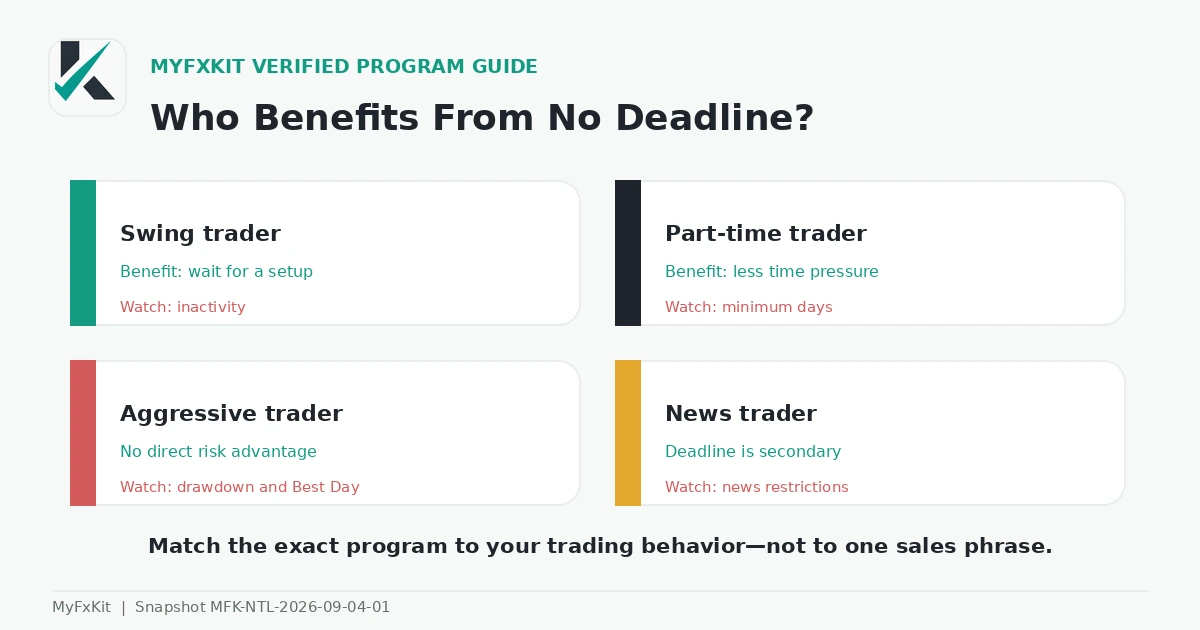
| Trader situation | Potential benefit | Rule to recheck |
|---|---|---|
| Swing trader with few setups | More time to wait for entry criteria | Inactivity and weekend holding |
| Part-time trader | Less pressure to trade every day | Minimum days and reset time |
| System with one large profit day | More time to rebalance results | Best Day and the consistency rule |
| News trader | No calendar deadline | News windows and eligible profit |
| Aggressive trader | Limited direct advantage | Daily loss, drawdown, and simultaneous risk |
If the absence of a consistency rule matters more than the deadline, use the separate no-consistency-rule program collection. A program can have no consistency condition in evaluation and still apply a Best Day requirement to a funded payout cycle.
The hidden cost of unlimited time
Unlimited time is not free. The challenge fee is paid upfront, and the purchase remains economically committed until the trader passes, stops, or breaches. A more expensive one-step program or a non-refundable fee does not become good value merely because the completion deadline is removed.
Compare these four figures together:
- Final checkout cost after discounts, taxes, and currency conversion.
- Number of phases and combined profit targets.
- Each phase’s target relative to usable maximum-loss room.
- Fee-refund conditions after the first eligible payout.
The fees in this article are dated observations. Four programs lacked an independently captured 100K price in the current extraction and were intentionally left for checkout verification. Filling an unknown field with an affiliate blog price would make the table look complete while making the decision less reliable.
Checklist for choosing a no-time-limit challenge
- Copy the exact program name, market, and size from checkout.
- Locate the unlimited-duration statement for the evaluation stage.
- Record minimum trading days and profitable days separately.
- Check inactivity rules for evaluation and funded stages.
- Confirm what counts as activity: opened, closed, or profitable trade.
- Record daily loss with its balance, equity, and reset-time formula.
- Determine whether maximum loss is static, absolute, or trailing.
- Check whether touching the threshold is a breach.
- Review Best Day and consistency rules in evaluation and payout cycles.
- Check news, weekend, EA, and copy-trading restrictions.
- Capture the final fee and refund policy in the payment currency.
- Save dated screenshots and links to the rules available on purchase day.
For traders with Iranian documents or residency considerations, no deadline is only one filter. Country eligibility, KYC, payment access, and payout routes require a separate check. Continue with prop firms for Iranian traders, the Iran payout guide, and the prop firm regulation guide.
How this collection is updated
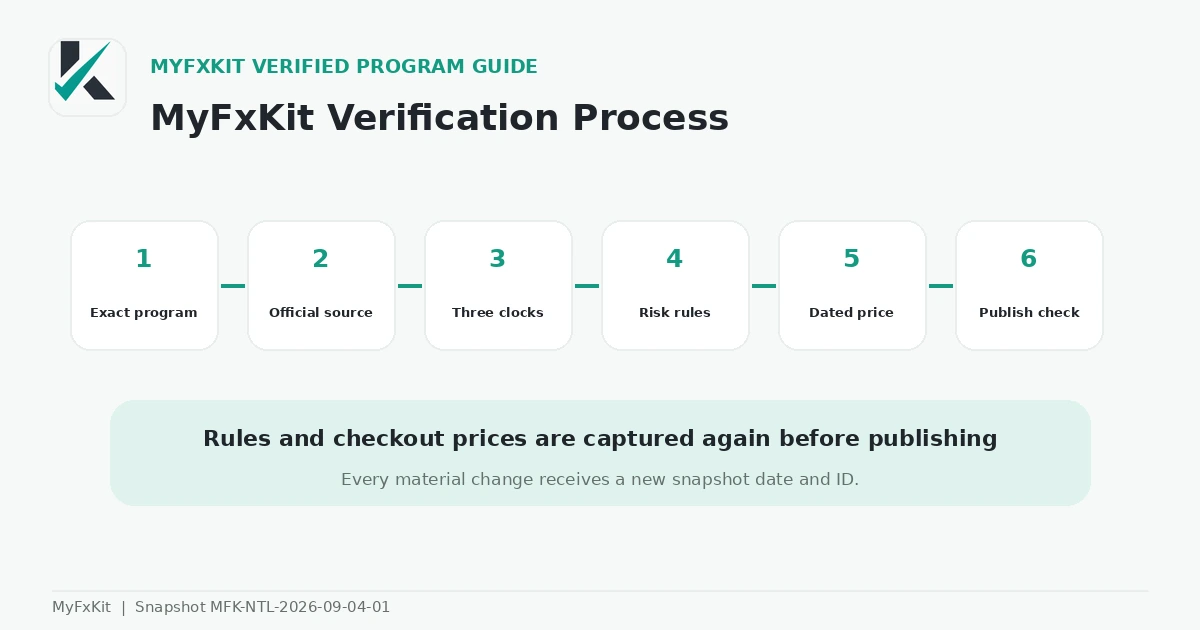
This page is scheduled for monthly review and an additional review after a material program change. Each cycle rechecks the exact name, completion duration, minimum days, inactivity, drawdown rules, and price. A conflicting source remains marked for review rather than silently replacing the earlier value.
Checkout prices should be recaptured immediately before publishing or updating. That is why some current table cells say “publication-day capture required” instead of showing an unsupported number. Verified changes belong in the MyFxKit change log. Readers can submit the exact program name, official link, and dated screenshot through the corrections page.
Official sources
- FTMO 1-Step Challenge
- FTMO 2-Step Challenge
- FTMO Trading Objectives
- FundedNext CFD Programs
- FundedNext Stellar 1-Step Rules
- FundedNext Stellar 2-Step Rules
- FundedNext Stellar Lite Rules
- E8 Pro
- E8 Pro Forex Rules
- The5ers High Stakes
- The5ers High Stakes General Rules
- FundingPips 2 Step Standard
Inclusion is not an endorsement of a firm, its payments, or its suitability. For broader research, use the prop firm directory and MyFxKit program collections.
Frequently asked questions
Does a no-time-limit prop challenge never expire?
It has no fixed deadline for reaching the profit target, but it may still have an inactivity rule. E8 Pro required activity within 60 days in this snapshot, while High Stakes and FundingPips used 30-day evaluation inactivity windows. Always check the exact program wording.
Does no deadline mean no minimum trading days?
No. FTMO 2-Step requires four days; the included Stellar programs require two to five days; High Stakes requires three profitable days; and FundingPips requires three trading days. FTMO 1-Step and E8 Pro had no official minimum-day requirement in the sampled rules.
What is the best prop firm with no time limit?
There is no defensible universal winner. The best fit depends on drawdown mechanics, loss allowance, minimum days, inactivity, price, KYC, and the trader’s strategy. The table is designed to build a shortlist, not announce an absolute winner.
Does unlimited time increase the chance of passing?
This dataset cannot establish that result. More time may reduce pressure to force trades, but pass rates depend on strategy, risk, rule execution, and trader behavior. A pass-rate claim requires a defined population and measurement method.
What happens if equity reaches the exact loss limit?
It depends on the exact program. FundingPips Standard states that touching or falling below its loss threshold is a violation. Keep an internal safety buffer above the official boundary and account for unrealized profit and loss.
When should I recheck the rules?
At minimum, check on purchase day, after passing each phase, and before requesting a payout. MyFxKit reviews this collection monthly and after observed program changes, but the official contract and dashboard available on the trading day remain the final operational reference.