
Which Prop Firm Rules Are Most Restrictive? A MyFxKit Data Study
Compare drawdown, consistency, time and payout rules across eight prop firm programs using MyFxKit’s transparent, auditable dataset.
There is no defensible way to identify the strictest prop firm rules with one percentage or one company name. One program may offer a larger maximum loss allowance but move its loss floor upward as the account grows. Another may use static drawdown but limit the amount of profit that can come from one day. A third may look flexible during evaluation and introduce extra conditions at payout.
This MyFxKit study compares eight named CFD programs from five brands in a dated, auditable snapshot. It does not declare a universally easiest or hardest firm. It identifies where rule pressure appears, how the mechanisms differ, and why a headline drawdown percentage is not enough to judge a challenge.
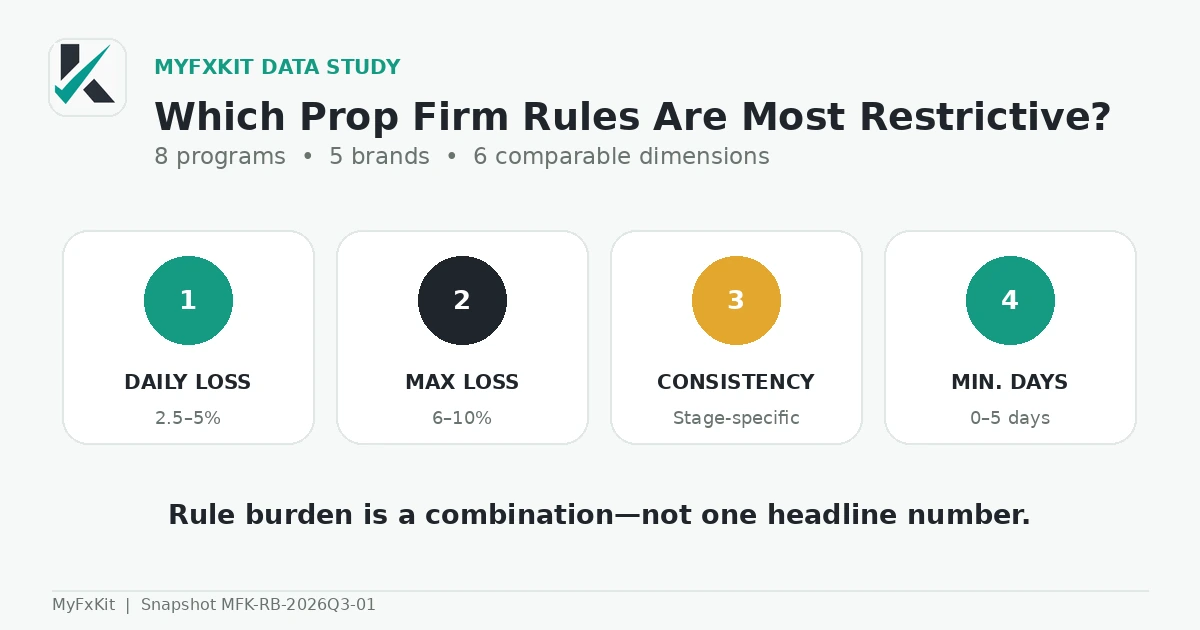
Short answer: daily loss limits in the sample ranged from 2.5% to 5%, while maximum loss limits ranged from 6% to 10%. Six of the eight programs required minimum trading or profitable days. Only one sampled program explicitly used end-of-day trailing maximum loss, yet that less common mechanism may matter more to some strategies than a frequent minimum-day rule. Consistency restrictions also had to be checked by program, stage, and payout cycle, not by brand name.
Author: MyFxKit Content Team · Data and technical review: MyFxKit Technical Team
Dataset snapshot: MFK-RB-2026Q3-01 · Sources observed September 3, 2026. The machine-readable records are available in the study dataset. Rules can change after the observation date, so confirm the official terms for the exact program and configuration before purchasing.
This is a descriptive study of rule structures in a purposive sample. It does not measure pass rates, payout probability, firm quality, or a causal relationship between any rule and trader performance.
Key findings
The comparable fields produced six primary findings:
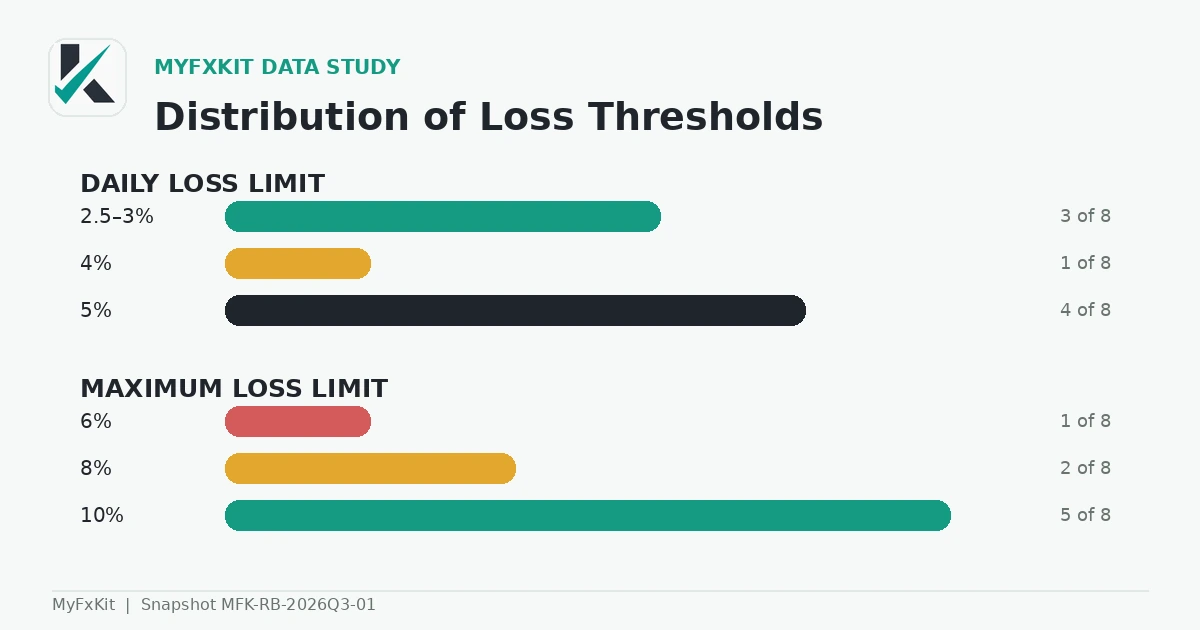
- Three programs had a daily loss limit of 3% or less, one had 4%, and four had 5%.
- Three programs had a maximum loss limit of 8% or less, while five displayed 10%.
- Six of the eight programs required minimum trading days or minimum profitable days.
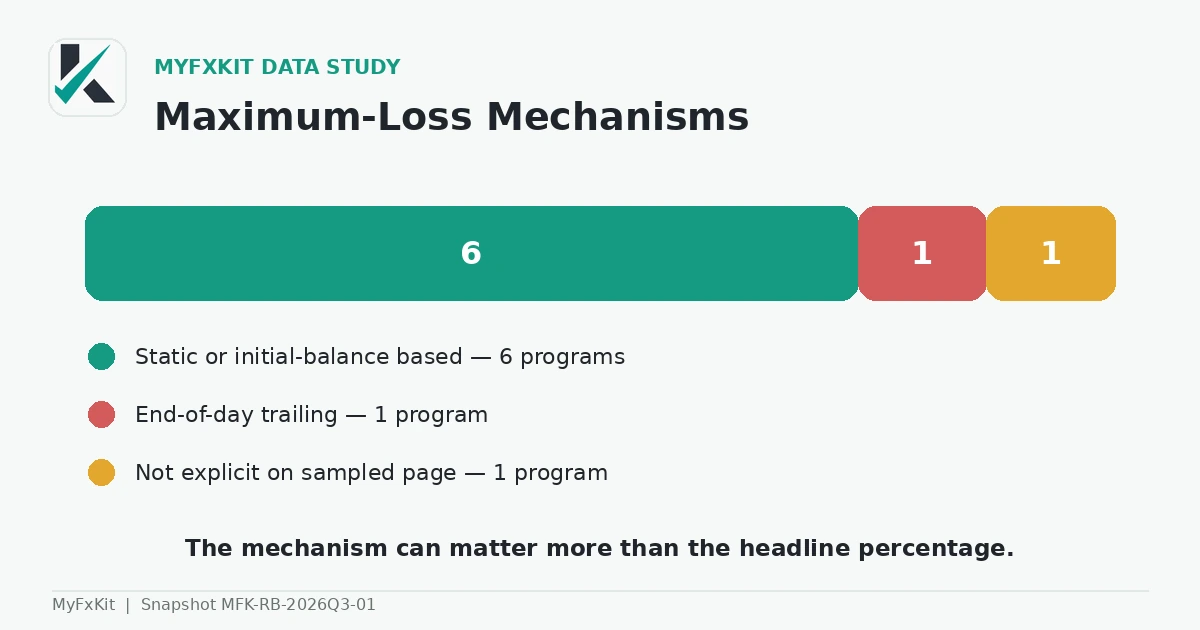
- Maximum-loss structure was static or initial-balance-based for six programs, end-of-day trailing for one, and not explicitly stated on the sampled page for one.
- Evaluation consistency status was frequently not explicit. Missing information remained
NA; it was never converted into “no rule.” - Funded-stage restrictions involving payout cycles, news trading, inactivity, or aggregate risk could materially change an evaluation-only comparison.
The practical question is therefore not simply “Which prop firm has the strictest rules?” It is which restriction creates the most pressure for a particular strategy at a particular account stage?
Study methodology
The unit of analysis was not a company. Each record represented the following combination:
brand + exact program + market + stage + configuration
The sample included FTMO Challenge 1-Step, FTMO Challenge 2-Step, FundedNext Stellar 1-Step CFD, FundedNext Stellar 2-Step CFD, FundedNext Stellar Lite CFD, E8 Pro Forex, The5ers High Stakes New, and FundingPips 2 Step Standard.
Inclusion logic
A program entered the snapshot when an accessible official product page or official help-center article identified its evaluation structure and supplied enough information to extract the daily and maximum loss limits. Futures programs, instant-funded products, and customized add-on configurations were not mixed with the standard CFD evaluation records.
This is a purposive sample, not an industry census. Some brands contribute more than one program, so the percentages describe these eight records only. They are not market-share estimates and should not be generalized to every prop firm. The broader research framework is documented in the MyFxKit methodology, while publication independence and correction standards are covered by the editorial policy.
Six primary comparison dimensions
| Dimension | Recorded field | Why it matters |
|---|---|---|
| Daily loss | Percentage, baseline, and reset timing | Controls how much adverse movement the account can absorb during one trading day |
| Maximum loss | Percentage and calculation reference | Defines the account’s total loss budget |
| Drawdown mechanism | Static, trailing, or unclear | Determines whether the loss floor moves upward with gains |
| Minimum days | Trading days or profitable days | Can delay completion after the profit target is reached |
| Consistency | Evaluation, funded, or payout-cycle status | Can restrict concentration of profits in one day |
| Time constraints | Completion deadline or inactivity rule | Can affect an account even without a loss-limit breach |
We deliberately did not combine these fields into one burden score. Equal weighting would create false precision. A 60-day inactivity rule is almost irrelevant to an active day trader, while a trailing floor may materially alter that trader’s available risk immediately after a profitable day.
How missing data were handled
Every relevant field was classified as one of three states:
- Present: the official source explicitly described the restriction.
- Explicitly absent: the official source directly stated that the restriction did not apply.
- Not stated or not reviewed: the field remained
NA.
Silence is not evidence of absence. A marketing page may omit a rule that appears in payout terms, a contract, or a different stage guide. For that reason, calculations use only records with sufficient evidence for the field being discussed.
Comparison table: eight prop firm programs
| Program | Evaluation target | Daily loss | Maximum loss | Maximum-loss type | Minimum days | Evaluation consistency |
|---|---|---|---|---|---|---|
| FTMO Challenge 1-Step | 10% | 3% | 10% | End-of-day trailing | None | 50% Best Day |
| FTMO Challenge 2-Step | 10% and 5% | 5% | 10% | Static | 4 trading days | Not listed in sampled objectives |
| Stellar 1-Step CFD | 10% | 3% | 6% | Initial-balance-based | 2 trading days | Not listed in sampled rules |
| Stellar 2-Step CFD | 8% and 5% | 5% | 10% | Static | 5 trading days | Not listed in sampled rules |
| Stellar Lite CFD | 8% and 4% | 4% | 8% | Initial-balance-based | 5 trading days | Not listed in sampled rules |
| E8 Pro Forex | 8% | 2.5% | 8% | Static | None | Explicitly none |
| The5ers High Stakes New | 10% and 5% | 5% | 10% | Not explicit on sampled page | 3 profitable days | Not listed on sampled page |
| FundingPips 2 Step Standard | 8% and 5% | 5% | 10% | Static | 3 trading days | Not listed in sampled evaluation rules |
These percentages are summaries, not complete breach formulas. The baseline, floating P&L treatment, server reset, and boundary operator can change the result. Some programs treat touching the exact threshold as a breach, while other wording refers to moving below a floor. Use the prop firm drawdown guide and drawdown calculator to test the exact formula rather than relying on the percentage alone.
Which daily loss limits were most restrictive?
On percentage alone, 2.5% and 3% daily loss limits provide less intraday room than 4% or 5%. E8 Pro Forex had the smallest sampled limit at 2.5%. FTMO 1-Step and FundedNext Stellar 1-Step each displayed 3%.
That does not make one of them universally hardest. The official E8 Pro Forex guide also describes a 2% daily profit cap: a trader may earn more, but only 2% of initial balance counts toward the target or daily performance. The program’s practical burden comes from the interaction between that cap, the 2.5% daily loss limit, and an 8% target.
The official FTMO trading objectives specify 3% daily loss for 1-Step and 5% for 2-Step, with daily recalculation at midnight CE(S)T. The 1-Step configuration also combines its smaller daily allowance with an end-of-day trailing maximum loss and a Best Day objective.
The FundedNext Stellar 1-Step rules specify 3% daily loss and 6% maximum loss. FundedNext’s daily-versus-maximum-loss explanation also shows that running and closed losses matter to the daily calculation. Traders with several open positions should therefore assess combined exposure, not just the stop on one order. The floating loss rule guide explains that portfolio-level risk separately.
Why a 10% maximum loss is not always easier
A 10% allowance looks more flexible than 6% or 8%, but only when the reference point and calculation mechanism are comparable. A static 10% floor and a trailing 10% floor do not preserve the same risk budget after the account grows.
Six sampled programs used a static or initial-balance-based maximum loss. FTMO 1-Step used an end-of-day trailing mechanism. The High Stakes page sampled for this field did not explicitly label its maximum-loss mechanism, so that value remained unknown rather than being inferred.
With static drawdown, gains usually increase the distance between current equity and the original loss floor. With trailing drawdown, the floor can rise after a new qualifying high. A nominal 10% trailing limit may therefore become more restrictive after profits than an 8% static limit. The static-versus-trailing section provides worked examples.
This is why a comparison page should store both maximum_loss_pct and drawdown_type. Displaying one without the other can create a materially incomplete impression of the challenge.
Minimum days: a simple rule that changes completion time
Six of the eight sampled programs required minimum days. FTMO 2-Step required four trading days. Stellar 1-Step required two, while Stellar 2-Step and Stellar Lite required five. FundingPips Standard required three trading days. The5ers High Stakes required three profitable days, which is a different test.
The official The5ers High Stakes page defines a profitable day using at least 0.5% positive closed profit under its displayed calculation. A trader who reaches the overall target in one large session may still need additional qualifying days. The FundingPips 2 Step Standard rules require at least three trading days in each evaluation phase.
Minimum-day requirements do not necessarily reduce the loss buffer. Their pressure is behavioral: they can encourage unnecessary activity after the target is effectively secured. A better response is to schedule the required days in advance and reduce risk as the account approaches its target.
Consistency rules must be checked by stage and consequence
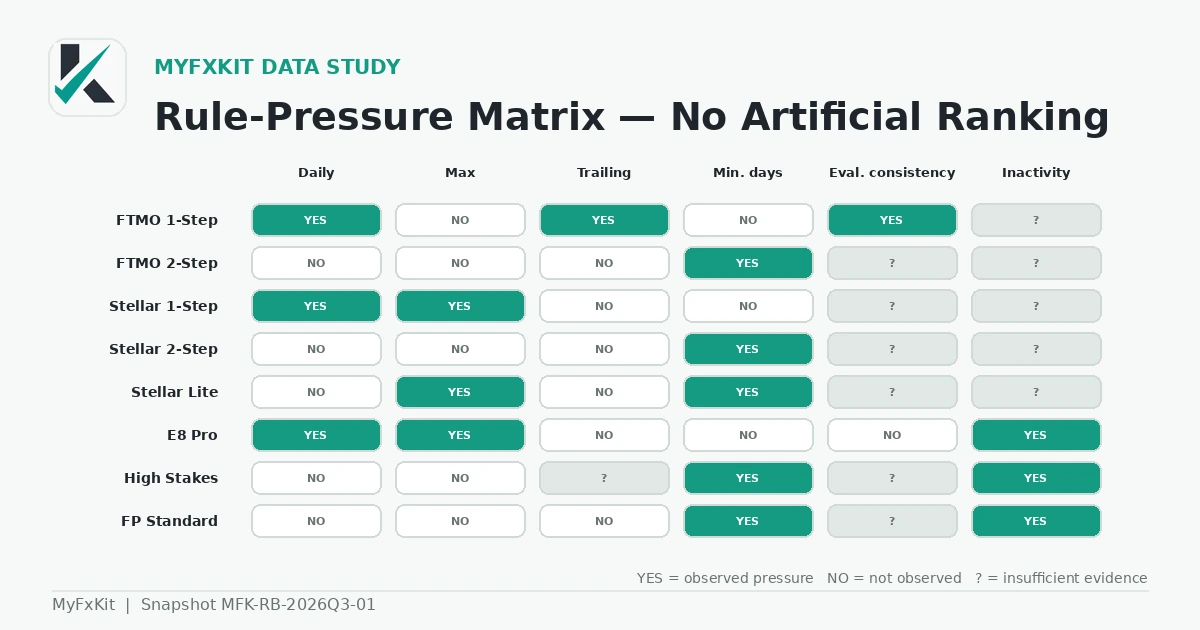
In this matrix, “daily” means a daily loss allowance of 3% or less, “maximum” means a maximum loss allowance of 8% or less, and “minimum days” means three or more required days. The remaining columns show documented trailing drawdown, evaluation consistency, or inactivity pressure. An unknown value is not the same as “no.” These thresholds are descriptive labels, not quality scores.
FTMO 1-Step applies a 50% Best Day objective during its challenge and subsequent 1-Step account. Under the official explanation, exceeding 50% is not an immediate breach. Instead, challenge completion or reward eligibility remains blocked until the ratio returns to the permitted level. This distinction between a hard breach and a completion or payout condition is operationally important.
The E8 consistency FAQ explicitly states that no consistency rule applies during the SimFi Challenge for Forex or Crypto products and that E8 Pro also has none at the Performance stage. That direct statement carries more evidentiary weight than simply failing to find the word “consistency” on a product page.
FundingPips Standard illustrates stage and configuration dependence. Its official page applies a 35% consistency score to the On Demand and Monthly reward cycles. An evaluation-stage summary therefore cannot be assumed to describe every payout option. See the prop firms without consistency rules study and the consistency rule formula guide for a stage-specific treatment.
Restrictions that headline comparison tables often miss
Three types of condition can materially affect a program without appearing beside the main drawdown percentages:
- Inactivity: the sampled E8 Pro guide required a closed trade within each 60-day period, while High Stakes and FundingPips referenced 30-day inactivity windows.
- News trading: High Stakes restricted order execution from two minutes before to two minutes after high-impact news. FundingPips published a separate news window for Master accounts.
- Risk and reward conditions: the standard FundedNext Stellar 2-Step funded table displayed maximum risk of 3% at any time and credited 40% of qualifying news profit.
The FundedNext CFD program tables separate Challenge Rules from Funded & Reward Rules. MyFxKit follows the same principle in its data model. Evaluation flexibility does not prove payout flexibility.
Country eligibility and payment routes are separate dimensions. Traders affected by cross-border restrictions should review the prop firms for Iranian traders comparison and the Iran payout guide rather than inferring access from challenge rules.
Frequency is not severity
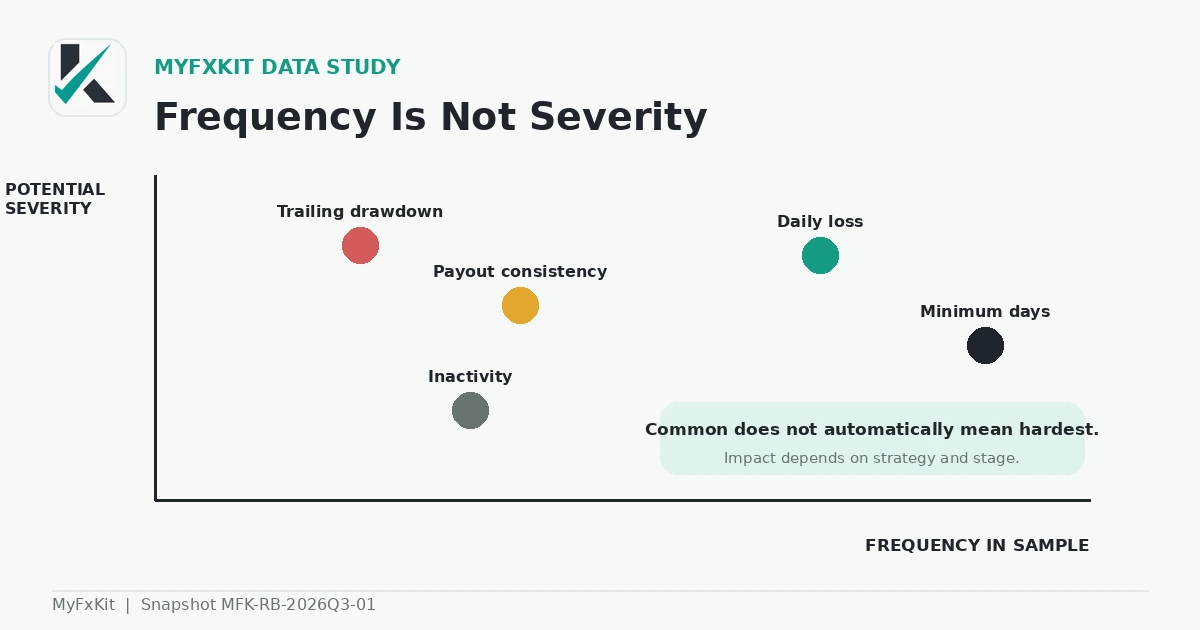
Minimum-day requirements were common in this sample, but they are not automatically the most severe. An active day trader may satisfy them without changing behavior. By contrast, trailing maximum loss appeared in only one sampled record yet may materially tighten that trader’s risk budget after a profitable close.
The practical effect of a rule depends on four factors:
- Strategy: scalping, swing trading, news trading, or a system with concentrated winning days.
- Stage: evaluation, verification, funded account, or reward request.
- Consequence: warning, delayed completion, profit removal, payout block, or hard breach.
- Interaction: how daily loss, open exposure, consistency, and timing rules operate together.
For that reason, MyFxKit reports a rule profile rather than inventing a universal burden score. A profile lets a trader identify the restrictions that intersect with actual behavior.
Rule pressure by trading style
| Trading style | More relevant restrictions | Question to answer before purchasing |
|---|---|---|
| High-frequency discretionary trader | Daily loss, aggregate risk, prohibited practices | Are related positions treated as one trade idea? |
| News trader | News window, profit removal, execution conditions | Does the rule restrict opening, closing, or holding? |
| Swing trader | Trailing drawdown, weekend holding, inactivity | When does the loss floor move, and which balance drives it? |
| Trader with large winning days | Best Day, daily profit cap, payout cycle | What denominator is used for the concentration ratio? |
Rule fit is only one trust dimension. Company registration, regulatory claims, contractual entity, and dispute history should be checked separately using the prop firm regulation guide. The MyFxKit firm directory, program collections, and prop rule center can then connect those trust checks to exact program records.
Official sources used
The snapshot was built from these official pages:
- FTMO Trading Objectives
- FTMO 1-Step Challenge
- FTMO 2-Step Challenge
- FundedNext Stellar 1-Step CFD Rules
- FundedNext Stellar 2-Step CFD Rules
- FundedNext Stellar Lite Rules
- FundedNext CFD Program Tables
- E8 Pro Forex Rules
- E8 Consistency Rule FAQ
- The5ers High Stakes
- The5ers High Stakes General Rules
- FundingPips 2 Step Standard
Inclusion here is not an endorsement. Official pages may change or conflict with another official document. When a conflict cannot be resolved, the corresponding field should remain unknown until stronger evidence is available.
Limitations
This study has five important limitations:
- Eight programs are not statistically representative of the full prop-firm market.
- Brand representation is unequal, so observed proportions are not market-share estimates.
- Some fields were not explicit on the sampled page and remained
NA. - Country, account size, add-ons, platform, and payout-cycle selections may change the applicable rules.
- The dataset contains no trader outcomes and cannot support pass-rate or causal claims.
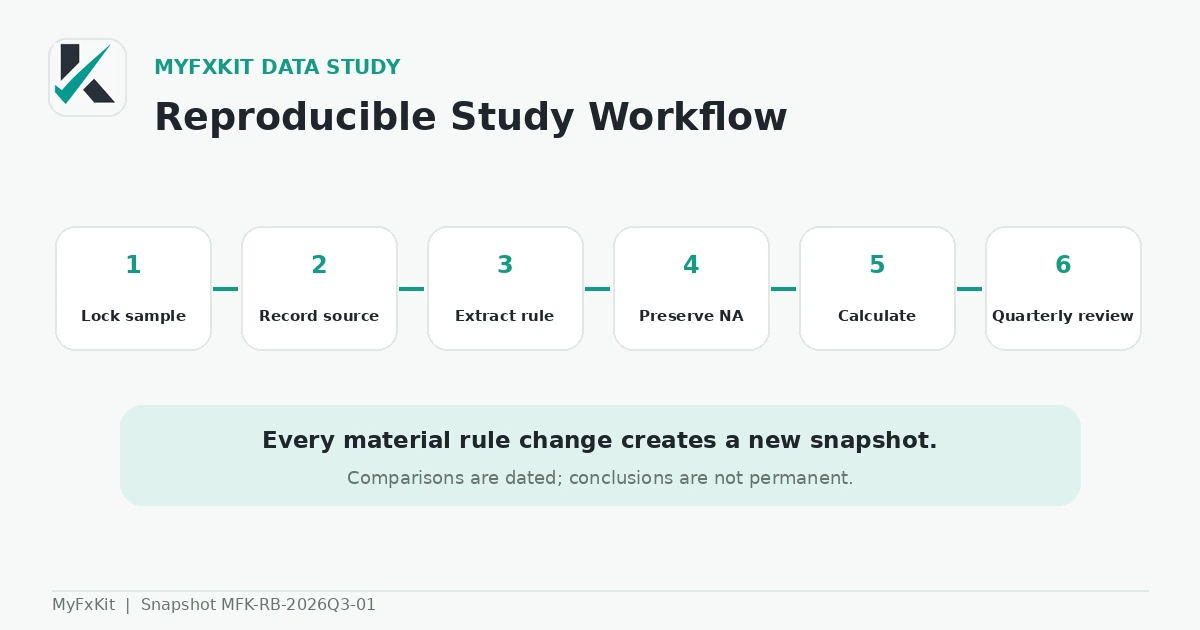
Future quarterly releases should preserve the inclusion logic and issue a new snapshot ID rather than silently overwriting historical observations. Material corrections should appear in the MyFxKit changelog. If you find a discrepancy, submit the official link, exact program, stage, configuration, and observation date through the corrections page.
Twelve-point challenge comparison checklist
- Record the exact program, market, account size, and platform.
- Read the daily loss percentage together with its baseline and reset time.
- Identify whether maximum loss is static, balance-based, or trailing.
- Confirm whether touching the exact boundary counts as a breach.
- Separate minimum trading days from minimum profitable days.
- Check consistency during evaluation and funded trading independently.
- Review the selected payout cycle for Best Day or consistency conditions.
- Read news, weekend, aggregate-risk, copying, and prohibited-strategy rules.
- Check inactivity even when the challenge advertises unlimited completion time.
- Compare the checkout configuration with the help-center documentation.
- Save dated screenshots and links for the rules shown at purchase.
- Test the rule combination against the real distribution of your trades.
Frequently asked questions
What is the strictest prop firm rule?
There is no universal answer. A small daily loss limit can be most restrictive for a volatile intraday strategy, trailing drawdown for an account that grows quickly, and Best Day for a strategy with concentrated wins. Severity must be evaluated against the strategy and stage.
Which sampled program was the most restrictive?
This study does not produce a final firm ranking. E8 Pro had the smallest daily loss allowance, Stellar 1-Step had the smallest maximum loss allowance, and FTMO 1-Step combined trailing maximum loss with a Best Day objective. Those are different types of pressure; adding them without validated weights would create a misleading score.
Is a 3% daily loss limit always stricter than 5%?
All else equal, 3% provides less intraday loss capacity. In real programs, the baseline, floating P&L treatment, reset time, maximum-loss mechanism, and consequence of touching the boundary also matter.
Why does “not listed” not mean “no rule”?
A restriction may appear in a contract, payout article, or separate stage guide. Only an explicit official statement supports “no rule.” Silence supports an unknown value, not an absence claim.
Does this dataset reveal prop challenge pass rates?
No. It contains rule fields, not purchaser counts, passing outcomes, payouts, or trader-level behavior. The observed frequencies cannot be used to estimate success probability.
How often will this study be updated?
The planned cadence is quarterly. Each release should receive a new snapshot ID and observation date so readers can distinguish current rules from historical records.
Conclusion
The sampled programs show that prop firm rule burden is multidimensional. A 2.5% daily limit can constrain one session; a 6% maximum limit reduces the total error budget; trailing drawdown changes the floor after gains; minimum days delay completion; and consistency can emerge only when the trader reaches a reward request.
The useful outcome is not a universal “strictest firm.” It is a comparison of the exact program, exact stage, exact formula, and exact consequence. Whenever the evidence is incomplete, the correct value is NA. That distinction is what separates an auditable rules study from a promotional ranking.